ORIGINAL PAPER
Integrating diet and exercise to effectively reduce fat mass in children with obesity during weight reduction program
1
Department of Human Nutrition and Dietetics, Poznan University of Life Sciences, Poznan, Poland
2
Department of Hygiene, Poznan University of Physical Education, Poznan, Poland Institute of Health and Physical Education, Jan Amos Komenski State University of Applied Sciences in Leszno, Leszno, Poland
Submission date: 2026-01-14
Final revision date: 2026-04-20
Acceptance date: 2026-04-23
Publication date: 2026-06-30
Pediatr Pol 2026;101(2):140-145
KEYWORDS
TOPICS
ABSTRACT
Introduction:
This study is aimed to evaluate the effects of total daily energy expenditure (TDEE) on fat mass (FM) reduction in children with obesity and to develop nomograms to support the planning of weight reduction programs in children.
Material and methods:
A total of 219 children with obesity aged 12–15 years participated in a 4-week summer camp weight reduction program. The intervention combined dietary energy restriction with various activities to increase exercise levels. Total daily energy expenditure was measured using continuous 24/7 HR monitoring. Changes in body weight and body composition – including fat mass, fat-free mass, and total body water – were measured using the bioelectrical impedance analysis.
Results:
On average, TDEE exceeded dietary energy intake by approximately 2590 kcal per 24 h, resulting in significant body weight and FM reductions. Fat mass loss was greater in boys (3.3 kg) than in girls (1.8 kg). The prescribed physical exercise lasted 3–4 h per day and accounted for an average of 32% of total daily expenditure. Boys’ total energy expenditure was markedly higher than that of girls, which corresponded to their significantly greater FM losses.
Conclusions:
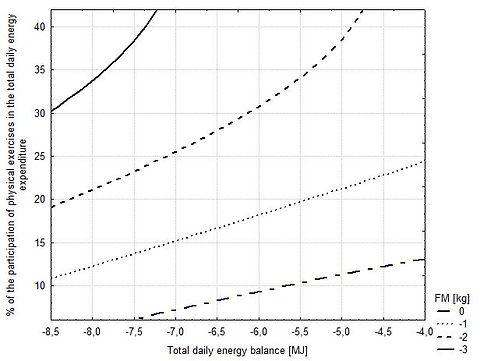
The weight reduction program proved effective for reducing FM in obese children. Fat mass loss was significantly affected not only by TDEE but also by the proportion of energy expended during therapeutic exercise, the energy cost of physical activity, and the overall daily energy balance of the participants. Individual engagement in physical activity was dependent on the degree of obesity at the start of the program. The results and the prepared nomogram can be used to develop recommendations for weight loss.
This study is aimed to evaluate the effects of total daily energy expenditure (TDEE) on fat mass (FM) reduction in children with obesity and to develop nomograms to support the planning of weight reduction programs in children.
Material and methods:
A total of 219 children with obesity aged 12–15 years participated in a 4-week summer camp weight reduction program. The intervention combined dietary energy restriction with various activities to increase exercise levels. Total daily energy expenditure was measured using continuous 24/7 HR monitoring. Changes in body weight and body composition – including fat mass, fat-free mass, and total body water – were measured using the bioelectrical impedance analysis.
Results:
On average, TDEE exceeded dietary energy intake by approximately 2590 kcal per 24 h, resulting in significant body weight and FM reductions. Fat mass loss was greater in boys (3.3 kg) than in girls (1.8 kg). The prescribed physical exercise lasted 3–4 h per day and accounted for an average of 32% of total daily expenditure. Boys’ total energy expenditure was markedly higher than that of girls, which corresponded to their significantly greater FM losses.
Conclusions:
The weight reduction program proved effective for reducing FM in obese children. Fat mass loss was significantly affected not only by TDEE but also by the proportion of energy expended during therapeutic exercise, the energy cost of physical activity, and the overall daily energy balance of the participants. Individual engagement in physical activity was dependent on the degree of obesity at the start of the program. The results and the prepared nomogram can be used to develop recommendations for weight loss.
REFERENCES (23)
1.
NCD Risk Factor Collaboration. Worldwide trends in underweight and obesity from 1990 to 2022: a pooled analysis of 3663 population- representative studies with 222 million children, adolescents, and adults. Lancet 2024; 403: 1027-1050.
2.
Orsini F, D’Ambrosio F, Scardigno A, Ricciardi R, Calabro G. Epidemiological impact of metabolic syndrome in overweight and obese European children and adolescents: a systematic literature review. Nutrients 2023; 15: 3895.
3.
Heffron S, Parham J, Pendse J, Alemán J. Treatment of obesity in mitigating metabolic risk. Circ Res 2020; 126: 1646-1665.
4.
Fowler LA, Grammer AC, Staiano AE, Fitzsimmons-Craft EE, Chen L, Yaeger LH, et al. Harnessing technological solutions for childhood obesity prevention and treatment: a systematic review and meta-analysis of current applications. Int J Obes 2021; 45: 957-981.
5.
Pauls D, Clausen L, Bruun J. Eating behavior profiles in children following a 10-week lifestyle camp due to overweight/obesity and low quality of life: a latent profile analysis on eating behavior. Eat Behav 2025; 57: 101971.
6.
Spiga F, Tomlinson E, Davies A, Moore TH, Dawson S, Breheny K, et al. Interventions to prevent obesity in children aged 12 to 18 years old. Cochrane Database Syst Rev 2024; 5: CD015330.
7.
Izzicupo P, Di Blasio A, Di Credico A, Ghinassi B, Capranica L, Napolitano G, et al. Objectively measured physical activity increases only in males during a summer camp for obese children. Front. Sports Act Living 2021; 3: 624449..
8.
Bradfield RB, Chan H, Bradfield NE, Payne PR. Energy expenditures and heart rates of cambridge boys at school. Am J Clin Nutr 1971; 24: 1461-1466.
9.
Spady DW. Total daily energy-expenditure of healthy, free ranging school-children. Am J Clin Nutr 1980; 33: 766-775.
10.
Regula J, Jeszka J, Gramza A. Effectiveness of weight reduction program in adolescents under sanatorium conditions in Poland including the role of diet and energy balance. Asia Pacific J Clin Nutr 2007; 16: 353-358.
11.
Bellissimo M, Fleischer C, Reiter D, Goss AM, Zhou L, Smith MR, et al. Sex differences in the relationships between body composition, fat distribution, and mitochondrial energy metabolism: a pilot study. Nutr Metab 2022; 19: 37.
12.
Muscogiuri G, Verde L, Vetrani C, Barrea L, Savastano S, Colao A. Obesity: a gender-view. J Endocrinol Invest 2023; 47: 299-306.
13.
Luan X, Tian XY, Zhang HX, Huang R, Li N, Chen P, et al. Exercise as a prescription for patients with various diseases. J Sport Health Sci 2019; 8: 422-441.
14.
Ashcroft S, Stocks B, Egan B, Zierath J. Exercise induces tissue- specific adaptations to enhance cardiometabolic health. Cell Metab 2024; 36: 278-300.
15.
Sandbakk O, Tonnessen E, Sandbakk S, Losnegard T, Seiler S, Haugen T. Best-practice training characteristics within olympic endurance sports as described by Norwegian world-class coaches. Sports Med Open 2025; 11: 45.
16.
Drenowatz C, Hand GA, Shook RP, Jakicic JM, Hebert JR, Bur- gess S, et al. The association between different types of exercise and energy expenditure in young nonoverweight and overweight adults. Appl Physiol Nutr Metab 2015; 40: 211-217.
17.
Berkowitz RI, Wadden TA, Gehrman CA, Bishop-Gilyard CT, Moore RH, Womble LG, et al. Meal replacements in the treatment of adolescent obesity: a randomized controlled trial. Obesity (Silver Spring) 2011; 19: 1193-1199.
18.
Raynor HA, Mazzeo SE, LaRose JG, Adams EL, Thornton LM, Caccavale LJ, et al. Effect of a high-intensity dietary intervention on changes in dietary intake and eating pathology during a multicomponent adolescent obesity intervention. Nutrients 2021; 13: 1850.
19.
Albert Pérez E, Mateu Olivares V, Martínez-Espinosa RM, Molina Vila MD, Reig García-Galbis M. New insights about how to make an intervention in children and adolescents with metabolic syndrome: diet, exercise vs. changes in body composition. A systematic review of RCT. Nutrients 2018; 10: 878.
20.
Bondyra-Wisniewska B, Myszkowska-Ryciak J, Harton A. Impact of lifestyle intervention programs for children and adolescents with overweight or obesity on body weight and selected cardiometabolic factors – a systematic review. Int J Environ Res Public Health 2021; 18:, 2061.
21.
Pyšná J, Pyšny L, Cihlar D, Petru D, Skopek M. Effect of physical activity on obesity in second stage pupils of elementary schools in Northwest Bohemia. Sustainability 2020; 12: 10042.
22.
Dettlaff-Dunowska M, Lemanowicz-Kustra A, Brzeziński M, Sowulewski O, Plata-Nazar K, Szlagatys-Sidorkiewicz A. Long-term trends in physical fitness and body mass among 10-year-olds in Gdansk: findings from a 12-year intervention programme. Pediatr Pol 2026; 101: 23-28.
23.
Koziol-Kozakowska A, Cichocka-Mroczek E, Wójcik M. Assessment of nutritional status and the occurrence of complications in children with obesity based on its severity. Pediatr Pol 2025; 100: 135-140.
Share
RELATED ARTICLE

We process personal data collected when visiting the website. The function of obtaining information about users and their behavior is carried out by voluntarily entered information in forms and saving cookies in end devices. Data, including cookies, are used to provide services, improve the user experience and to analyze the traffic in accordance with the Privacy policy. Data are also collected and processed by Google Analytics tool (more).
You can change cookies settings in your browser. Restricted use of cookies in the browser configuration may affect some functionalities of the website.
You can change cookies settings in your browser. Restricted use of cookies in the browser configuration may affect some functionalities of the website.