ORIGINAL PAPER
Cleft lip and palate in newborns: 17 years of institutional research and clinical experience
1
Department of Neonatology, Clinic for Children’s Diseases, University Clinical Hospital Mostar, Bosnia and Herzegovina
2
School of Medicine, University of Mostar, Mostar, Bosnia and Herzegovina
Submission date: 2026-02-12
Final revision date: 2026-03-27
Acceptance date: 2026-04-21
Publication date: 2026-06-30
Pediatr Pol 2026;101(2):134-139
KEYWORDS
TOPICS
ABSTRACT
Introduction:
The aim of the study is to show the frequency and characteristics of newborns with cleft lip (CL), cleft palate (CP), and cleft lip and palate (CLP) and their mothers at our clinical center over a 17-year period.
Material and methods:
A retrospective study was conducted in the period from January 2009 to December 2025 at the Department of Neonatology and the Department of Intensive Care for Children (Neonatal Intensive Care Unit) the Cli- nic for Children’s Diseases of the University Clinical Hospital in Mostar. The study included 51 newborns and their mothers who were diagnosed with one of the orofacial clefts (CL, CP (hard and soft palate) and CLP) during pregnancy or after birth.
Results:
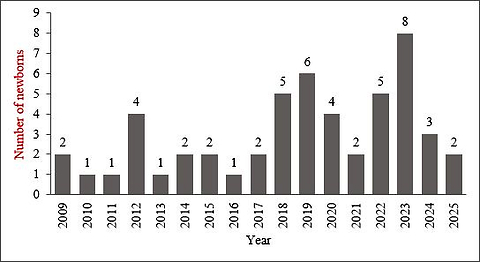
Of the 29,544 infants born at the University Clinical Hospital in Mostar between January 1, 2009 and December 31, 2025, 51 newborns (0.17%) were treated for congenital orofacial clefts (CL, CP, CLP). In the last eight years of the study, 68.6% (35/51) of cases of CL, CP and CLP in newborns were recorded which is significantly higher than in the previous 9 years when 31.4% (16/51) of such newborns were recorded (p = 0.008). The results indicate a significant dominance of CL and hard and soft palate (22) and (17) cleft soft palate (p = 0.002), 39/51 newborns. In 24 of 51 newborns (47.1%), an orofacial cleft was detected during pregnancy. Isolated congenital orofacial clefts without other pathological conditions were present in 20 newborns, while 31 of them also had other pathological conditions and/or congenital anomalies of other organ systems (p = 0.123).
Conclusions:
During the 17-year study, the incidence of oral cavity malformations (CL, CP, CLP) in newborns was low compared to the number of births at our clinical center. Nevertheless, we must not forget the importance of screening, diagnosing and monitoring pregnant women with such malformations in their newborns for better neonatal care and favorable treatment outcomes.
The aim of the study is to show the frequency and characteristics of newborns with cleft lip (CL), cleft palate (CP), and cleft lip and palate (CLP) and their mothers at our clinical center over a 17-year period.
Material and methods:
A retrospective study was conducted in the period from January 2009 to December 2025 at the Department of Neonatology and the Department of Intensive Care for Children (Neonatal Intensive Care Unit) the Cli- nic for Children’s Diseases of the University Clinical Hospital in Mostar. The study included 51 newborns and their mothers who were diagnosed with one of the orofacial clefts (CL, CP (hard and soft palate) and CLP) during pregnancy or after birth.
Results:
Of the 29,544 infants born at the University Clinical Hospital in Mostar between January 1, 2009 and December 31, 2025, 51 newborns (0.17%) were treated for congenital orofacial clefts (CL, CP, CLP). In the last eight years of the study, 68.6% (35/51) of cases of CL, CP and CLP in newborns were recorded which is significantly higher than in the previous 9 years when 31.4% (16/51) of such newborns were recorded (p = 0.008). The results indicate a significant dominance of CL and hard and soft palate (22) and (17) cleft soft palate (p = 0.002), 39/51 newborns. In 24 of 51 newborns (47.1%), an orofacial cleft was detected during pregnancy. Isolated congenital orofacial clefts without other pathological conditions were present in 20 newborns, while 31 of them also had other pathological conditions and/or congenital anomalies of other organ systems (p = 0.123).
Conclusions:
During the 17-year study, the incidence of oral cavity malformations (CL, CP, CLP) in newborns was low compared to the number of births at our clinical center. Nevertheless, we must not forget the importance of screening, diagnosing and monitoring pregnant women with such malformations in their newborns for better neonatal care and favorable treatment outcomes.
REFERENCES (23)
1.
Dixon MJ, Marazita ML, Beaty TH, Murray JC. Cleft lip and palate: understanding genetic and environmental influences. Nat Rev Genet 2011; 12: 167-178.
2.
Jašić M, Trifoni N, Milevoj Ražem M, Zupičić B, Kalagac Fabris L. Epidemiological characteristics of newborns with cleft lip and/or palate in the Pula General Hospital in a 10-year period (2003-2012). Glas Pul Bol 2014; 11: 34-37.
3.
Mitchell LE. Epidemiology of cleft lip and palate. In: Losee JE, Kirschner RE (eds.). Comprehensive cleft care. Georg Thieme 2016.
4.
Putri FA, Pattamatta M, Anita SES, Maulina T. The global occurrences of cleft lip and palate in pediatric patients and their association with demographic factors: a narrative review. Children (Basel) 2024; 11: 322.
5.
Luijsterburg AJ, Rozendaal AM, Vermeij Keers C. Classifying common oral clefts: a new approach after descriptive registration. Cleft Palate Craniofac J 2014; 51: 381- 391.
6.
Stott Miller M, Heike CL, Kratz M, Starr JR. Increased risk of orofacial clefts associated with maternal obesity: case-control study and Monte Carlo-based bias analysis. Paediatr Perinat Epidemiol 2010; 24: 502-512.
7.
Houston M. Taking folic acid at start of pregnancy seems to lower risk of cleft lip and palate. BMJ 2012; 345: e4616.
8.
Gaxiola AC, Dowswell T, Pena Rosas JP. Effects and safety of periconceptional folate supplementation for preventing birth defects. Cochrane Database Syst Rev 2010; 10: CD007950.
9.
Corsello G, Giuffrè M. Congenital malformations. J Matern Fetal Neonatal Med 2012; 1: 25-29.
10.
Magdalenić Meštrović M, Bagatin M. An epidemiological study of orofacial clefts in Croatia 1988–1998. J Craniomaxillofac Surg 2005; 33: 85-90.
11.
Molnárová A, Fekiačová D, Záhumenský J, Rosoľanková M, Ujhá- zy E, Dubovický M, Palenčár D. Relationship between COVID-19 and orofacial clefts. Gen Physiol Biophys 2024; 43: 313-319.
12.
Sabbagh HJ, AlSharif MT, Abdulhameed FD, Aljohar AJ, Alhus- sain RM, Alghamdi SM, et al. Maternal exposure to stress during COVID-19 and non-syndromic orofacial clefts: a cohort retrospective study. Cleft Palate Craniofac J 2025; 62: 601-609.
13.
Wu GH, Warden C, Zimmerman CE, Kalmar CL, Humphries LS, McDonald-McGinn DM, et al. Poverty and risk of cleft lip and palate: an analysis of United States birth data. Plast Reconstr Surg 2022; 149: 169-182.
14.
Slah-Ud-Din S, Ali K, Mahd SM, Nisar S, Nisar O. Factors associated with an increased risk of facial malformations. Cureus 2023; 15: 41641.
15.
Silva AMD, Calumby RT, Freitas VS. Epidemiologic profile and prevalence of live births with orofacial cleft in Brazil: a descriptive study. Rev Paul Pediatr 2023; 42: 2022234.
16.
Martelli DR, Coletta RD, Oliveira EA, Swerts MSO, Rodrigues LAM, Oliveira MC, et al. Association between maternal smoking, gender, and cleft lip and palate. Braz J Otorhinolaryngol 2015; 81: 514-9.
17.
Khoury MJ, Gomez-Farias M, Mulinare J. Does maternal cigarette smoking during pregnancy cause cleft lip and palate in offspring? Am J Dis Child 1989; 143: 333-337.
18.
Widayanti N, Danila A, Syohanda W. Parity as a risk factor of children with cleft lip. J Plast Rekonstruksi 2018; 4: 119-123.
19.
Paaske EB, Garne E. Epidemiology of orofacial clefts in a Danish county over 35 years – before and after implementation of a prenatal screening programme for congenital anomalies. Eur J Med Genet 2018; 61: 489-492.
20.
Setó-Salvia N, Stanier P. Genetics of cleft lip and/or cleft palate: association with other common anomalies. Eur J Med Genet 2014; 57: 381-393.
21.
Stoll C, Alembick Y, Roth MP. Associated anomalies in Pierre Robin sequence. Am J Med Genet A 2023; 191: 2312-2323.
22.
Vyas T, Gupta P, Kumar S, Gupta R, Gupta T, Singh HP: Cleft of lip and palate: a review. J Family Med Prim Care 2020; 9: 2621-2625.
23.
Loomis-Goltl E, Briley P, Kotlarek KJ. Impact of prenatal care on newborn complications for infants with cleft lip with or without cleft palate. Cleft Palate Craniofac J 2024; 61: 1041-1051.
Share
RELATED ARTICLE

We process personal data collected when visiting the website. The function of obtaining information about users and their behavior is carried out by voluntarily entered information in forms and saving cookies in end devices. Data, including cookies, are used to provide services, improve the user experience and to analyze the traffic in accordance with the Privacy policy. Data are also collected and processed by Google Analytics tool (more).
You can change cookies settings in your browser. Restricted use of cookies in the browser configuration may affect some functionalities of the website.
You can change cookies settings in your browser. Restricted use of cookies in the browser configuration may affect some functionalities of the website.