Editor's Choice
ORIGINAL PAPER
Long-term trends in physical fitness and body mass among 10- year-olds in Gdansk: findings from a 12-year intervention programme
1
Department of Paediatrics, Gastroenterology, Allergology and Paediatric Nutrition, Medical University of Gdansk, Gdansk, Poland
Submission date: 2025-11-18
Final revision date: 2025-11-27
Acceptance date: 2025-11-30
Publication date: 2026-03-10
Corresponding author
Magdalena Dettlaff-Dunowska
Magdalena Dettlaff-Dunowska, Department of Paediatrics, Gastroenterology, Allergology and Paediatric Nutrition, Medical University of Gdansk, Gdansk, Poland
Magdalena Dettlaff-Dunowska, Department of Paediatrics, Gastroenterology, Allergology and Paediatric Nutrition, Medical University of Gdansk, Gdansk, Poland
Pediatr Pol 2026;101(1):23-28
KEYWORDS
physical fitnesscardiorespiratory fitnesschildhood obesityKasch pulse recovery testpreventive health
TOPICS
ABSTRACT
Introduction:
Physical fitness in childhood is a critical determinant of long-term health, influencing the risk of cardiometabolic and emotional disorders in adulthood. The Kasch pulse recovery test (KPRT) is a simple, non-invasive tool for assessing cardiorespiratory fitness (CRF) in population-based studies. This study evaluated the relationship between body mass index (BMI) and physical fitness in 10-year-old children from Gdansk, Poland, over a 12-year period (2011–2023), focusing on sex differences and the impact of the COVID-19 pandemic.
Material and methods:
A total of 19,614 children (9,416 girls and 10,198 boys) participating in the health preventive programme were assessed. Body mass index was calculated using anthropometric measurements and categorized as underweight, normal weight, or overweight/obese according to the national centile grids. Physical fitness was evaluated using the KPRT, a 3-minute step test, with heart rate (HR) monitored post- exercise. Data were analysed using χ2 tests and ANOVA (p < 0.05), comparing BMI categories, KPRT scores, and HR across study years and between sexes.
Results:
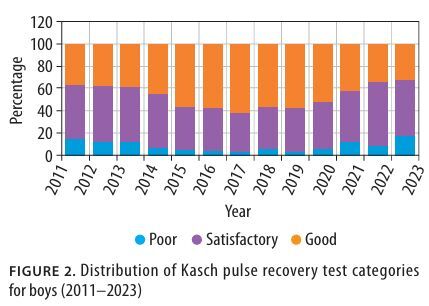
Girls consistently outperformed boys in KPRT scores across all BMI categories (p ≤ 0.05), with a higher proportion of ‘good’ ratings (e.g. 74.9% for girls vs. 61.5% for boys in 2019). Overweight children, especially boys, exhibited significantly poorer KPRT scores (57.1% ‘poor’ ratings in 2023) and higher post-exercise HR (e.g. 139 beats per minute (bpm) for overweight girls vs. 127 bpm for boys in 2023). A positive trend in fitness was observed in the 2015–2019 period, with lower HR (e.g. 114 bpm for girls, 106 bpm for boys in 2017), but fitness declined post-2020, with ‘good’ KPRT ratings dropping to 45.1% (girls) and 32.1% (boys) in 2023, alongside higher HR.
Conclusions:
Overweight children, especially boys, are at a greater risk of reduced physical fitness, highlighting the need for targeted interventions. The Kasch pulse recovery test proved effective as a screening tool for assessing CRF in children.
Physical fitness in childhood is a critical determinant of long-term health, influencing the risk of cardiometabolic and emotional disorders in adulthood. The Kasch pulse recovery test (KPRT) is a simple, non-invasive tool for assessing cardiorespiratory fitness (CRF) in population-based studies. This study evaluated the relationship between body mass index (BMI) and physical fitness in 10-year-old children from Gdansk, Poland, over a 12-year period (2011–2023), focusing on sex differences and the impact of the COVID-19 pandemic.
Material and methods:
A total of 19,614 children (9,416 girls and 10,198 boys) participating in the health preventive programme were assessed. Body mass index was calculated using anthropometric measurements and categorized as underweight, normal weight, or overweight/obese according to the national centile grids. Physical fitness was evaluated using the KPRT, a 3-minute step test, with heart rate (HR) monitored post- exercise. Data were analysed using χ2 tests and ANOVA (p < 0.05), comparing BMI categories, KPRT scores, and HR across study years and between sexes.
Results:
Girls consistently outperformed boys in KPRT scores across all BMI categories (p ≤ 0.05), with a higher proportion of ‘good’ ratings (e.g. 74.9% for girls vs. 61.5% for boys in 2019). Overweight children, especially boys, exhibited significantly poorer KPRT scores (57.1% ‘poor’ ratings in 2023) and higher post-exercise HR (e.g. 139 beats per minute (bpm) for overweight girls vs. 127 bpm for boys in 2023). A positive trend in fitness was observed in the 2015–2019 period, with lower HR (e.g. 114 bpm for girls, 106 bpm for boys in 2017), but fitness declined post-2020, with ‘good’ KPRT ratings dropping to 45.1% (girls) and 32.1% (boys) in 2023, alongside higher HR.
Conclusions:
Overweight children, especially boys, are at a greater risk of reduced physical fitness, highlighting the need for targeted interventions. The Kasch pulse recovery test proved effective as a screening tool for assessing CRF in children.
REFERENCES (30)
1.
Mintjens S, Menting MD, Daams JG, van Poppel MNM, Rose-boom TJ, Gemke RJBJ. Cardiorespiratory fitness in childhood and adolescence affects future cardiovascular risk factors: a systematic review of longitudinal studies. Sports Med 2018; 48: 2577-2605.
2.
Calcaterra V, Cena H, Rossi V, Santero S, Bianchi A, Zuccotti G. Ultra- processed food, reward system and childhood obesity. Children 2023; 10: 804.
3.
Ekelund U, Luan J, Sherar LB, Esliger DW, Griew P, Cooper A. Moderate to vigorous physical activity and sedentary time and cardiometabolic risk factors in children and adolescents. JAMA 2012; 307: 704-712.
4.
Ruiz JR, Ortega FB, Labayen I. A weight loss diet intervention has a similar beneficial effect on both metabolically abnormal obese and metabolically healthy but obese premenopausal women. Ann Nutr Metab 2013; 62: 223-230.
5.
Ortega FB, Ruiz JR, Castillo MJ, Sjöström M. Physical fitness in childhood and adolescence: a powerful marker of health. Int J Obes (Lond) 2008; 32: 1-11.
6.
Williamson DF, Madans J, Anda RF, Kleinman JC, Kahn HS, Byers T. Recreational physical activity and ten-year weight change in a us national cohort. Int J Obes RelatMetab Disord J Int Assoc Study Obes 1993; 17: 279-286.
7.
Schmitz KH, Jacobs DRJ, Leon AS, Schreiner PJ, Sternfeld B. Physical activity and body weight: associations over ten years in the CARDIA study. Coronary artery risk development in young adults. Int J Obes Relat Metab Disord J Int Assoc Study Obes 2000; 24: 1475-1487.
8.
Lemanowicz-Kustra A, Brzeziński M, Dettlaff-Dunowska M, Borkowska A, Materek M, Jagiełło K, et al. Body weight changes during childhood and predictors of excessive body weight in adolescence-a longitudinal analysis. Nutrients 2024; 16: 4397.
9.
Jankowski M, Niedzielska A, Brzezinski M, Drabik J. Cardiorespiratory fitness in children: a simple screening test for population studies. Pediatr Cardiol 2015; 36: 27-32.
10.
Kułaga Z, Grajda A, Gurzkowska B, Góźdź M, Wojtyło M, Świąder A, et al. Polish 2012 growth references for preschool children. Eur J Pediatr 2013; 172: 753-761.
11.
Raghuveer G, Hartz J, Lubans DR, Takken T, Wiltz JL, Mietus-Snyder M, et al. Cardiorespiratory fitness in youth: an important marker of health: a scientific statement from the American Heart Association. Circulation 2020; 142: E101-E118.
12.
Dettlaff-Dunowska M, Brzeziński M, Zagierska A, Borkowska A, Zagierski M, Szlagatys-Sidorkiewicz A. Changes in body composition and physical performance in children with excessive body weight participating in an integrated weight-loss programme. Nutrients 2022; 14: 3647.
13.
Calcaterra V, Vandoni M, Pellino VC, Cena H. Special attention to diet and physical activity in children and adolescents with obesity during the coronavirus disease-2019 pandemic. Front Pediatr 2020; 8: 8-10.
14.
Welling MS, Abawi O, van den Eynde E, van Rossum EFC, Halberstadt J, Brandsma AE, et al. Impact of the COVID-19 pandemic and related lockdown measures on lifestyle behaviors and well-being in children and adolescents with severe obesity. Obes Facts 2022; 15: 186-196.
15.
Runacres A, Mackintosh KA, Knight RL, Sheeran L, Thatcher R, Shelley J, et al. Impact of the COVID-19 pandemic on sedentary time and behaviour in children and adults: a systematic review and meta-analysis. Int J Environ Res Public Health 2021; 18: 11286.
16.
Chambonnière C, Fearnbach N, Pelissier L, Genin P, Fillon A, Boscaro, et al. Adverse collateral effects of COVID-19 public health restrictions on physical fitness and cognitive performance in primary school children. Int J Environ Res Public Health 2021; 18: 11099.
17.
Aleksova A, Lucia, A, Gagno G, Pierri A, Padoan L, Derin A, et al. Long-term effect of SARS-CoV-2 infection on cardiovascular outcomes and all-cause mortality. Life Sci 2022; 310: 121018.
18.
Bakhtiari E, Moazzen N. Pulmonary function in children post- SARS-CoV-2 infection: a systematic review and meta-analysis. BMC Pediatr 2024; 24: 87.
19.
Luo D, Mei B, Wang P, Li X, Chen X, Wei G, et al. Prevalence and risk factors for persistent symptoms after COVID-19: a systematic review and meta-analysis. Clin Microbiol Infect 2024; 30: 328-335.
20.
Taher MK, Salzman T, Banal A, Morissette K, Domingo FR, Cheung AM, et al. Global prevalence of post-COVID-19 condition: a systematic review and meta-analysis of prospective evidence. Heal Promot Chronic Dis Prev Canada Res Policy Pract 2025; 45: 112-138.
21.
Drenowatz C, Ferrari G, Greier K, Chen S, Hinterkörner F. Physical fitness in Austrian elementary school children prior to and post-COVID-19. AIMS Public Health 2023; 10: 480-495.
22.
Teich P, Fühner T, Bähr F, Puta C, Granacher U, Kliegl R. COVID pandemic effects on the physical fitness of primary school children : results of the German EMOTIKON project. Sports Med Open 2023; 9: 77.
23.
Schoeffl I, Raming R, Philipp J, Adrian T, Calvin PR, Waellisch W, et al. Cardiopulmonary function in paediatric post‑COVID‑19 : a controlled clinical trial. Eur J Pediatr 2024; 183: 1645-1655.
24.
Ludwig-Walz H, Heinisch S, Siemens W, Niessner C, Eberhardt T, Dannheim I, et al. Trends in physical fitness among children and adolescents in Europe: a systematic review and meta-analyses during and after the COVID-19 pandemic. J Sport Heal Sci 2025; 15: 101101.
25.
Metelska P, Brzeziński M, Szarszewski A. Child health status from the parents perspective – judgement accuracy verification. Eur J Public Health 2021; 31: ckab165.300.
26.
Carson V, Hunter S, Kuzik N, Gray CE, Poitras VJ, Chaput JP, et al. Systematic review of sedentary behaviour and health indicators in school-aged children and youth: an update. Appl Physiol Nutr Metab 2016; 41: S240-S265.
27.
Moore SA, Faulkner G, Rhodes RE, Brussoni M, Chulak- Bozzer T, Ferguson LJ, et al. Impact of the COVID-19 virus outbreak on movement and play behaviours of Canadian children and youth: a national survey. Int J Behav Nutr Phys Act 2020; 17: 1-11.
28.
Kretschmer L, Salali GD, Andersen LB, Hallal PC, Northstone K, Sardinha LB, et al. Gender differences in the distribution of children’s physical activity: evidence from nine countries. Int J Behav Nutr Phys Act 2023; 20: 1-10.
29.
Gronwald T, Schaffarczyk M, Reinsberger C, Hoos O. Heart rate variability – methods and analysis in sports medicine and exercise science. Dtsch Z Sportmed 2024; 75: 113-118.
30.
Plaza-Florido A, Migueles JH, Mora-Gonzalez J, Molina-Garcia P, Rodriguez-Ayllon M, Cadenas-Sanchez C, et al. Heart rate is a better predictor of cardiorespiratory fitness than heart rate variabi- lity in overweight/obese children: the activebrains project. Front Physiol 2019; 10: 510.
Share
RELATED ARTICLE

We process personal data collected when visiting the website. The function of obtaining information about users and their behavior is carried out by voluntarily entered information in forms and saving cookies in end devices. Data, including cookies, are used to provide services, improve the user experience and to analyze the traffic in accordance with the Privacy policy. Data are also collected and processed by Google Analytics tool (more).
You can change cookies settings in your browser. Restricted use of cookies in the browser configuration may affect some functionalities of the website.
You can change cookies settings in your browser. Restricted use of cookies in the browser configuration may affect some functionalities of the website.