ORIGINAL PAPER
What the pediatrician should know about different types of severe combined immunodeficiency: a single-center experience
1
Department of Immunology, The Children’s Memorial Health Institute, Warsaw, Poland
2
Histocompatibility Laboratory, The Children’s Memorial Health Institute, Warsaw, Poland
3
Department of Clinical Microbiology and Immunology, The Children’s Memorial Health Institute, Warsaw, Poland
Submission date: 2025-06-21
Final revision date: 2025-10-05
Acceptance date: 2025-10-05
Publication date: 2026-03-10
Corresponding author
Nel Dąbrowska-Leonik
Nel Dąbrowska-Leonik, MD, Department of Immunology, The Children’s Memorial Health Institute, Warsaw, Poland
Nel Dąbrowska-Leonik, MD, Department of Immunology, The Children’s Memorial Health Institute, Warsaw, Poland
Pediatr Pol 2026;101(1):8-16
KEYWORDS
TOPICS
ABSTRACT
Introduction:
Severe combined immunodeficiency (SCID) is the most serious inborn error of immunity, lethal if untreated. There are three SCID subtypes: typical (TS), atypical (AS) and Omenn syndrome (OS). The goal of this study is to characterize clinical and immunogenetic aspects of patients with different aforementioned types of SCID diagnosed in a single center and an attempt to select factors improving diagnosis in the areas without newborn screening.
Material and methods:
This is a retrospective evaluation of the clinical course and hematological, biochemical, immunological and genetic tests leading to SCID diagnosis in 42 children.
Results:
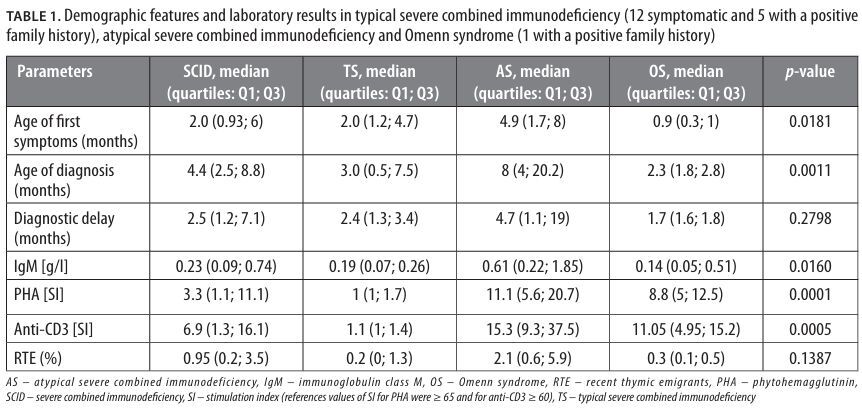
Median age of diagnosis was 4.4 months, higher for AS (8 months, p < 0.05). Median diagnostic delay (DD) was 2.5 months (4.7 months in AS children). Suspicion of the disease was raised by pediatricians (in 44.4% of all children), hematologists (19.4% of all children, 26.3% of AS children, with DD of 20 months), or dermatologists. The first symptoms were infections (64%), rash (22.2%), chronic diarrhea (5.6%), anemia (5.6%) and lymphopenia (2.8%). At the time of diagnosis, 79.5% of patients presented with lymphopenia. The median of recent thymic emigrants was 0.2%, 2.1%, 0.3% in TS, AS and OS, respectively. The most frequent pathogenic variants were found in the following genes: IL2RG (23.8%), RAG1/2 (16.6%), JAK3 (14.3%), ADA (11.9%) and IL7RA (4.8%). The overall survival rate was 69% in all children.
Conclusions:
The diagnosis of SCID was established significantly later in the case of AS than TS and OS. The type of first symptoms does not differ between particular types of SCID. Lymphopenia is the most common symptom and the most often underestimated laboratory sign of SCID.
Severe combined immunodeficiency (SCID) is the most serious inborn error of immunity, lethal if untreated. There are three SCID subtypes: typical (TS), atypical (AS) and Omenn syndrome (OS). The goal of this study is to characterize clinical and immunogenetic aspects of patients with different aforementioned types of SCID diagnosed in a single center and an attempt to select factors improving diagnosis in the areas without newborn screening.
Material and methods:
This is a retrospective evaluation of the clinical course and hematological, biochemical, immunological and genetic tests leading to SCID diagnosis in 42 children.
Results:
Median age of diagnosis was 4.4 months, higher for AS (8 months, p < 0.05). Median diagnostic delay (DD) was 2.5 months (4.7 months in AS children). Suspicion of the disease was raised by pediatricians (in 44.4% of all children), hematologists (19.4% of all children, 26.3% of AS children, with DD of 20 months), or dermatologists. The first symptoms were infections (64%), rash (22.2%), chronic diarrhea (5.6%), anemia (5.6%) and lymphopenia (2.8%). At the time of diagnosis, 79.5% of patients presented with lymphopenia. The median of recent thymic emigrants was 0.2%, 2.1%, 0.3% in TS, AS and OS, respectively. The most frequent pathogenic variants were found in the following genes: IL2RG (23.8%), RAG1/2 (16.6%), JAK3 (14.3%), ADA (11.9%) and IL7RA (4.8%). The overall survival rate was 69% in all children.
Conclusions:
The diagnosis of SCID was established significantly later in the case of AS than TS and OS. The type of first symptoms does not differ between particular types of SCID. Lymphopenia is the most common symptom and the most often underestimated laboratory sign of SCID.
REFERENCES (30)
1.
Dvorak CC, Haddad E, Heimall J, Dunn E, Buckley RH, Kohn DB, et al. The diagnosis of severe combined immunodeficiency (SCID): The Primary Immune Deficiency Treatment Consortium (PIDTC) 2022 Definitions. J Allergy Clin Immunol 2023; 151: 539-546.
2.
Brown L, Xu-Bayford J, Allwood Z, Slatter M, Cant A, Davies EG, et al. Neonatal diagnosis of severe combined immunodeficiency leads to significantly improved survival outcome: the case for newborn screening. Blood 2011; 117: 3243-3246.
3.
Piątosa B, Wolska-Kusnierz B, Siewiera K, Grzduk H, Gałkowska E, Bernatowska E. Distribution of leukocyte and lymphocyte subsets in peripheral blood. Age related normal values for preliminary evaluation of the immune status in Polish children. Centr Eur J Immunol 2010; 35: 168-175.
4.
Abraham RS, Basu A, Heimall JR, Dunn E, Yip A, Kapadia M, et al. Relevance of lymphocyte proliferation to PHA in severe combined immunodeficiency (SCID) and T cell lymphopenia. Clin Immunol 2024; 261: 109942.
5.
Pichler WJ, Tilch J. The lymphocyte transformation test in the diagnosis of drug hypersensitivity. Allergy 2004; 59: 809-820.
6.
Wolska-Kusnierz B, Pac M, Piatosa B, Pac, Kurenko-Deptuch M, Heropolitańska-Pliszka B, et al. Wartości referencyjne stężeń immunoglobulin G, A, M i D w surowicy zdrowych dzieci i osób dorosłych, mieszkańców województwa mazowieckiego. Standard Med Pediatr 2010; 3: 524-532.
7.
Kreins AY, Dhalla, F, Flinn AM, Howley E, Ekwall O, Villa A, et al. European Society for Immunodeficiencies Clinical Working Party. European Society for Immunodeficiencies guidelines for the management of patients with congenital athymia. J Allergy Clin Immunol 2024; 18: S0091-6749(24)00980-1.
8.
Bernatowska E, Wolska-Kuśnierz B, Pac M, Kurenko-Deptuch M, Pietrusza B, Zwolska Z, et al. Risk of BCG infection in primary immunodeficiency children. Proposal of diagnostic, prophylactic and therapeutic guidelines for disseminated BCG based on experience in the Department of Immunology, Children’s Memorial Health Institute in Warsaw between 1980–2006. Centr Eur J Immunol 2007; 32: 221-225.
9.
European Society for Immunodeficiences (ESID) Clinical Working Party Diagnostic Criteria for PID: BCG Diagnostic Criteria. Available from: https://archive.esid.org/Media... (accessed: 14.04.2025).
10.
Sharapova SO, Skomska-Pawliszak M, Rodina YA, Wolska-Kuśnierz B, Dabrowska-Leonik N, Mikołuć B, et al. The clinical and genetic spectrum of 82 patients with RAG deficiency including a c.256_257delAA founder variant in Slavic countries. Front Immunol 2020; 11: 900.
11.
Wolska-Kuśnierz B. Evaluation of treatment outcomes and immune system reconstitution in patients with primary immunodeficiencies following hematopoietic stem cell transplantation. Dissertation. The Children’s Memorial Health Institute, Warsaw 2008.
12.
Blom M, Soomann M, Soler-Palacín P, Šedivá A, Stray-Pedersen A, Zetterström R, et al. Newborn screening for SCID and severe T lymphocytopenia in Europe. J Allergy Clin Immunol 2024; 6: S0091-6749(24)01162-X.
13.
Giżewska M, Durda K, Winter T, Ostrowska I, Ołtarzewski M, Klein J, et al. Newborn screening for SCID and other severe primary immunodeficiency in the Polish-German transborder area: experience from the first 14 months of collaboration. Front Immunol 2020; 11: 1948.
14.
Mazalon M, Grześk E, Dąbrowska A, Urbańczyk A, Kołtan S. The significance of medical history and its impact on the early diagnosis of inborn error of immunity. Pediatr Pol 2024; 99: 246-249.
15.
Lev A, Somech R, Somekh I. Newborn screening for severe combined immunodeficiency and inborn errors of immunity. Curr Opin Pediatr 2023; 35: 692-702.
16.
Bernatowska E, Skomsa-Pawliszak M, Wolska-Kuśnierz B, Pac M, Heropolitanska-Pliszka E, Pietrucha B, et al. BCG moreau vaccine safety profile and NK cells-double protection against disseminated BCG infection in retrospective study of BCG vaccination in 52 Polish children with severe combined immunodeficiency. J Clin Immunol 2020; 40: 138-146.
17.
Poyraz A, Cansever M, Muderris I, Patiroglu T. Neonatal lymphopenia screening is important for early diagnosis of severe combined immunodeficiency. Am J Perinatol 2023; 40: 748-752.
18.
Delmonte OM, Villa A, Notarangelo LD. Immune dysregulation in patients with RAG deficiency and other forms of combined immune deficiency. Blood 2020; 135: 610-619.
19.
Farmer JR, Foldvari Z, Ujhazi B, de Ravin SS, Chen K, Bleesing JJH, et al. Outcomes and treatment strategies for autoimmunity and hyperinflammation in patients with RAG deficiency. J Allergy Clin Immunol Pract 2019; 7: 1970-1985.e4.
20.
Min Q, Csomos K, Li Y, Dong L, Hu Z, Meng X, et al. B cell abnormalities and autoantibody production in patients with partial RAG deficiency. Front Immunol 2023; 14: 1155380.
21.
Vignesh P, Rawat A, Kumrah R, Singh A, Gummadi A, Sharma M, et al. Clinical, immunological, and molecular features of severe combined immune deficiency: a multi-institutional experience from India. Front Immunol 2021; 11: 619146.
22.
Speckmann C, Nennstiel U, Hönig M, Albert MH, Ghosh S, Schuetz C, et al. Prospective newborn screening for SCID in Germany: a first Analysis by the Pediatric Immunology Working Group (API). J Clin Immunol 2023; 27: 1-14.
23.
De Pagter AP, Bredius RG, Kuijpers TW, Tramper J, van der Burg M, van Montfrans J, et al. Overview of 15-year severe combined immunodeficiency in the Netherlands: towards newborn blood spot screening. Eur J Pediatr 2015; 174: 1183-1188.
24.
Yao CM, Han XH, Zhang YD, Zhang H, Jin YY, Cao RM, et al. Clinical characteristics and genetic profiles of 44 patients with severe combined immunodeficiency (SCID): report from Shanghai, China (2004-2011). J Clin Immunol 2013; 33: 526-539.
25.
Lee PP, Chan KW, Chen TX, Jiang LP, Wang XC, Zeng HS, et al. Molecular diagnosis of severe combined immunodeficiency – identification of IL2RG, JAK3, IL7R, DCLRE1C, RAG1, and RAG2 mutations in a cohort of Chinese and Southeast Asian children. J Clin Immunol 2011; 31: 281-296.
26.
Al Sukaiti N, Ahmed K, Alshekaili J, Al Kindi M Cook MC, Al Farsi T. A decade experience on severe combined immunodeficiency phenotype in Oman, bridging to newborn screening. Front Immunol 2021; 11: 623199.
27.
Abolhassani H, Chou J, Bainter W, Platt CD, Tavassoli M, Momen T, et al. Clinical, immunologic, and genetic spectrum of 696 patients with combined immunodeficiency. J Allergy Clin Immunol 2018; 141: 1450-1458.
28.
Ikinciogullari A, Cagdas D, Dogu F, Tugrul T, Karasu G, Haskologlu S, et al. Turkish pediatric bone marrow transplantation sub group (TPBMT-SG). Clinical features and HSCT outcome for SCID in Turkey. J Clin Immunol 2019;39: 316-323.
29.
Cirillo E, Cancrini C, Azzari C, Martino S, Martire B, Pession A, et al. Clinical, immunological, and molecular features of typical and atypical severe combined immunodeficiency: report of the Italian primary immunodeficiency network. Front Immunol 2019; 10: 1908.
30.
Pasic S, Vujic D, Veljković D, Slavkovic B, Mostarica-Stojkovic M, Minic P, et al. Severe combined immunodeficiency in Serbia and Montenegro between years 1986 and 2010: a single-center experience. J Clin Immunol 2014; 34: 304-308.

We process personal data collected when visiting the website. The function of obtaining information about users and their behavior is carried out by voluntarily entered information in forms and saving cookies in end devices. Data, including cookies, are used to provide services, improve the user experience and to analyze the traffic in accordance with the Privacy policy. Data are also collected and processed by Google Analytics tool (more).
You can change cookies settings in your browser. Restricted use of cookies in the browser configuration may affect some functionalities of the website.
You can change cookies settings in your browser. Restricted use of cookies in the browser configuration may affect some functionalities of the website.