Editor's Choice
ORIGINAL PAPER
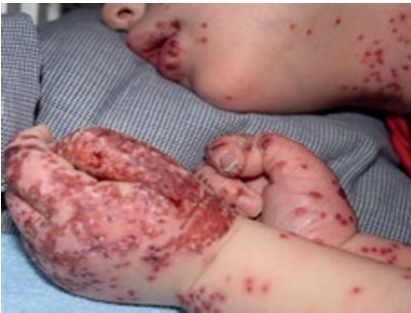
Viral skin infections in pediatric patients with atopic
dermatitis – a single-center retrospective study
1
Department of Dermatology, Pediatric Dermatology and Dermatological Oncology, Medical University of Lodz, Lodz, Poland
2
Laboratory of Autoinflammatory, Genetic and Rare Skin Disorders at Department of Dermatology, Pediatric Dermatology and Dermatological Oncology, Medical University of Lodz, Lodz, Poland
These authors had equal contribution to this work
Submission date: 2025-05-08
Final revision date: 2025-10-20
Acceptance date: 2025-10-28
Publication date: 2026-01-15
Pediatr Pol 2026;101(1):1-7
KEYWORDS
TOPICS
ABSTRACT
Introduction:
Atopic dermatitis (AD) is a chronic pediatric skin disease characterized by pruritus, eczematous lesions, and xerosis, and is often complicated by infections of different etiopathology. This study analyzed the most frequent viral skin infections in children with AD admitted to the dermatology department.
Material and methods:
This retrospective single-center study enrolled 77 pediatric patients aged 1–18 years with a diagnosis of AD and coexisting viral skin infections caused by the molluscum contagiosum virus (MCV), herpes simplex virus (HSV), human papillomavirus (HPV), or enteroviruses. Patients were recruited over a five-year period, from January 2018 to December 2022. Collected data included age, sex, patient distribution by year and month, and treatment strategies.
Results:
The cohort consisted of 36 males (46.8%) and 41 females (53.2%). Among the viral infections, those caused by MCV were the most prevalent, accounting for 49.4% of cases, while HPV infections were the least common, representing 9.1%. Although no statistically significant differences were found in the monthly distribution of infections, notable variations were observed between June and several other months. All patients with MCV infections underwent curettage. Only patients with HSV infections received systemic acyclovir therapy. Ten patients (13.0%) were treated with advanced therapies for AD, including cyclosporine, methotrexate, dupilumab, or phototherapy.
Conclusions:
Viral skin infections are a clinically significant comorbidity in pediatric patients with AD, most commonly caused by the molluscum contagiosum virus. The highest incidence was observed in 2018, while the decline in 2019–2020 was likely influenced by the COVID-19 pandemic and related lockdown measures. Treatment strategies varied depending on the viral etiology, with MCV managed by curettage, while HSV was treated with systemic acyclovir. Eczema herpeticum was associated with a more severe disease course, emphasizing the need for early recognition and prompt antiviral therapy. These findings highlight the importance of individualized, etiology-driven management in pediatric patients with AD and viral skin infections.
Atopic dermatitis (AD) is a chronic pediatric skin disease characterized by pruritus, eczematous lesions, and xerosis, and is often complicated by infections of different etiopathology. This study analyzed the most frequent viral skin infections in children with AD admitted to the dermatology department.
Material and methods:
This retrospective single-center study enrolled 77 pediatric patients aged 1–18 years with a diagnosis of AD and coexisting viral skin infections caused by the molluscum contagiosum virus (MCV), herpes simplex virus (HSV), human papillomavirus (HPV), or enteroviruses. Patients were recruited over a five-year period, from January 2018 to December 2022. Collected data included age, sex, patient distribution by year and month, and treatment strategies.
Results:
The cohort consisted of 36 males (46.8%) and 41 females (53.2%). Among the viral infections, those caused by MCV were the most prevalent, accounting for 49.4% of cases, while HPV infections were the least common, representing 9.1%. Although no statistically significant differences were found in the monthly distribution of infections, notable variations were observed between June and several other months. All patients with MCV infections underwent curettage. Only patients with HSV infections received systemic acyclovir therapy. Ten patients (13.0%) were treated with advanced therapies for AD, including cyclosporine, methotrexate, dupilumab, or phototherapy.
Conclusions:
Viral skin infections are a clinically significant comorbidity in pediatric patients with AD, most commonly caused by the molluscum contagiosum virus. The highest incidence was observed in 2018, while the decline in 2019–2020 was likely influenced by the COVID-19 pandemic and related lockdown measures. Treatment strategies varied depending on the viral etiology, with MCV managed by curettage, while HSV was treated with systemic acyclovir. Eczema herpeticum was associated with a more severe disease course, emphasizing the need for early recognition and prompt antiviral therapy. These findings highlight the importance of individualized, etiology-driven management in pediatric patients with AD and viral skin infections.
REFERENCES (30)
1.
Napolitano M, Fabbrocini G, Martora F, Genco L, Noto M, Patruno C. Children atopic dermatitis: diagnosis, mimics, overlaps, and therapeutic implication. Dermatol Ther 2022; 35: e15901.
2.
Ren Z, Silverberg JI. Association of atopic dermatitis with bacterial, fungal, viral, and sexually transmitted skin infections. Dermatitis 2020; 31: 157-164.
3.
Hanifin J, Rajka G. Diagnostic features of atopic eczema. Acta Derm Venereol 1980; 92: 44-47.
4.
Eichenfield LF, Tom WL, Chamlin SL, Feldman SR, Hanifin JM, Simpson EL, et al. Guidelines of care for the management of atopic dermatitis: section 1. diagnosis and assessment of atopic dermatitis. J Am Acad Dermatol 2014; 70: 338-351.
5.
Williams HC, Burney PG, Hay RJ, Archer CB, Shipley MJ, Hun- ter JJ, et al. The U.K. Working Party’s diagnostic criteria for atopic dermatitis. I. Derivation of a minimum set of discriminators for atopic dermatitis. Br J Dermatol 1994; 131: 383-396.
6.
Saeki H, Ohya Y, Arakawa H, Ichiyama S, Katsunuma T, Katoh N, et al. Executive summary: Japanese guidelines for atopic dermatitis (ADGL) 2024. Allergol Int 2025; 74: 210-221.
7.
Nutten S. Atopic dermatitis: global epidemiology and risk factors. Ann Nutr Metab 2015; 66: 8-16.
8.
Sun D, Ong PY. Infectious complications in atopic dermatitis [published correction appears in Immunol Allergy Clin North Am 2017; 37: xiii]. Immunol Allergy Clin North Am 2017; 37: 75-93.
9.
Wollenberg A, Werfel T, Ring J, Ott H, Gieler U, Weidinger S. Atopic dermatitis in children and adults – diagnosis and treatment. Dtsch Arztebl Int 2023; 120: 224-234.
10.
Kanda N, Hoashi T, Saeki H. The roles of sex hormones in the course of atopic dermatitis. Int J Mol Sci 2019; 20: 4660.
11.
Johansson EK, Bergström A, Kull I, Melén E, Jonsson M, Lundin S, et al. Prevalence and characteristics of atopic dermatitis among young adult females and males: report from the Swedish population-based study BAMSE. J Eur Acad Dermatol Venereol 2022; 36: 698-704.
12.
Silverberg JI, Hanifin JM. Adult eczema prevalence and associations with asthma and other health and demographic factors: a US population-based study. J Allergy Clin Immunol 2013; 132: 1132-1138.
13.
Krämer U, Weidinger S, Darsow U, Möhrenschlager M, Ring J, Behrendt H. Seasonality in symptom severity influenced by temperature or grass pollen: results of a panel study in children with eczema. J Invest Dermatol 2005; 124: 514-523.
14.
Zhang YT, Li HM, Zhang YJ, Tan C, Xie B. Seasonal changes in the severity of atopic dermatitis by birth season: a pilot prospective cohort study. Acta Derm Venereol 2025; 105: adv41987.
15.
Narla S, Silverberg JI. Association between childhood atopic dermatitis and cutaneous, extracutaneous and systemic infections. Br J Dermatol 2018; 178: 1467-1468.
16.
Ong PY, Leung DY. Bacterial and viral infections in atopic dermatitis: a comprehensive review. Clin Rev Allergy Immunol 2016; 51: 329-337.
17.
Leung AKC, Barankin B, Hon KLE. Molluscum contagiosum: an update. Recent Pat Inflamm Allergy Drug Discov 2017; 11: 22-31.
18.
Meza-Romero R, Navarrete-Dechent C, Downey C. Molluscum contagiosum: an update and review of new perspectives in etiology, diagnosis, and treatment. Clin Cosmet Investig Dermatol 2019; 12: 373-381.
19.
Harel A, Kutz AM, Hadj-Rabia S, Mashiah J. To treat molluscum contagiosum or not – curettage: an effective, well-accepted treatment modality. Pediatr Dermatol 2016; 33: 640-645.
20.
De Koning MN, Quint KD, Bruggink SC, Gussekloo J, Bouwes Bavinck JN, Feltkamp MCW, et al. High prevalence of cutaneous warts in elementary school children and the ubiquitous presence of wart-associated human papillomavirus on clinically normal skin. Br J Dermatol 2015; 172: 196-201.
21.
Ockenfels HM. Therapeutic management of cutaneous and genital warts. J Dtsch Dermatol Ges 2016; 14: 892-899.
22.
Zhu P, Qi RQ, Yang Y, Huo W, Zhang Y, He L, et al. Clinical guideline for the diagnosis and treatment of cutaneous warts. J Evid Based Med 2022; 15: 284-301.
23.
Bristow I. Paediatric cutaneous warts and verrucae: an update. Int J Environ Res Public Health 2022; 19: 16400.
24.
Zhu P, Ji W, Li D, Li Z, Chen Y, Dai B, et al. Current status of hand-foot-and-mouth disease. J Biomed Sci 2023; 30: 15.
25.
Korhonen L, Kondrashova A, Tauriainen S, Haapala AM, Huhtala H, Ilonen J, et al. Enterovirus infections in early childhood and the risk of atopic disease: a nested case-control study. Clin Exp Allergy 2013; 43: 625-632.
26.
Korhonen L, Seiskari T, Lehtonen J, Puustinen L, Surcel HM, Haapala AM, et al. Enterovirus infection during pregnancy is inversely associated with atopic disease in the offspring. Clin Exp Allergy 2018; 48: 1698-1704.
27.
Lee ZM, Huang YH, Ho SC, Kuo HC. Correlation of symptomatic enterovirus infection and later risk of allergic diseases via a population-based cohort study. Medicine (Baltimore) 2017; 96: e5827.
28.
Palmu T, Lehtonen J, Korhonen L, Virtanen SM, Niemelä O, Toppari J, et al. Association of different enteroviruses with atopy and allergic diseases in early childhood. Pediatr Allergy Immunol 2021; 32: 1629-1636. 29.
29.
Traidl S, Roesner L, Zeitvogel J, Werfel T. Eczema herpeticum in atopic dermatitis. Allergy 2021; 76: 3017-3027.
30.
Moran MC, Klose A, Yoshida T, de Benedetto A, Schneider LC, Ong PY, et al. History of S. aureus skin infection significantly associates with history of eczema herpeticum in patients with atopic dermatitis. Dermatol Ther (Heidelb) 2023; 13: 2417-2429.
Share

We process personal data collected when visiting the website. The function of obtaining information about users and their behavior is carried out by voluntarily entered information in forms and saving cookies in end devices. Data, including cookies, are used to provide services, improve the user experience and to analyze the traffic in accordance with the Privacy policy. Data are also collected and processed by Google Analytics tool (more).
You can change cookies settings in your browser. Restricted use of cookies in the browser configuration may affect some functionalities of the website.
You can change cookies settings in your browser. Restricted use of cookies in the browser configuration may affect some functionalities of the website.