ORIGINAL PAPER
Establishing normative values for palpebral fissure length in Polish children: implications for foetal alcohol syndrome diagnosis
1
Anthropology Laboratory, The Children’s Memorial Health Institute, Warsaw, Poland
2
Department of Child and Adolescent Health, Institute of Mother and Child, Warsaw, Poland
Submission date: 2025-11-14
Final revision date: 2026-01-20
Acceptance date: 2026-03-26
Publication date: 2026-06-30
Pediatr Pol 2026;101(2):122-127
KEYWORDS
TOPICS
ABSTRACT
Introduction:
Foetal alcohol syndrome (FAS) is a serious condition resulting from prenatal alcohol exposure, often characterised by distinct facial features. The goal of this study is to demonstrate the need to develop reference distributions for the width of the palpebral fissure in the Polish population, as this is one of the most important characteristics applicable to the diagnostic FAS syndrome.
Material and methods:
The research involved 210 children (102 girls and 108 boys) aged 3–16 years (mean age 9.57 years). The palpebral fissure lengths were measured using a computerised method applied to digital photographs. The images were labelled solely by the child’s sex and birth date. The study participants were primarily recruited from patients admitted to the Children’s Memorial Health Institute and their siblings. An additional sample of 38 children was recruited from scientific events. The study took place between 2019–2023.
Results:
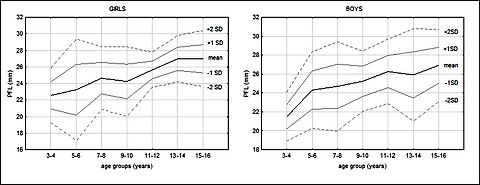
The measurements were grouped into two-year age categories. A statistical hypothesis test was performed to assess the assumption that the palpebral fissure length (PFL) of the right eye is equal to that of the left eye. The mean values of PFL were classified by age and gender groups. The analysis revealed that PFL increases with age, and there is a slight, though not statistically significant, difference between boys and girls in each age group
Conclusions:
These data have important implications for the accurate diagnosis and management of FAS and related disorders. By addressing the identified limitations and expanding research efforts, future studies can build on this foundation, ultimately enhancing clinical outcomes and supporting public health initiatives.
Foetal alcohol syndrome (FAS) is a serious condition resulting from prenatal alcohol exposure, often characterised by distinct facial features. The goal of this study is to demonstrate the need to develop reference distributions for the width of the palpebral fissure in the Polish population, as this is one of the most important characteristics applicable to the diagnostic FAS syndrome.
Material and methods:
The research involved 210 children (102 girls and 108 boys) aged 3–16 years (mean age 9.57 years). The palpebral fissure lengths were measured using a computerised method applied to digital photographs. The images were labelled solely by the child’s sex and birth date. The study participants were primarily recruited from patients admitted to the Children’s Memorial Health Institute and their siblings. An additional sample of 38 children was recruited from scientific events. The study took place between 2019–2023.
Results:
The measurements were grouped into two-year age categories. A statistical hypothesis test was performed to assess the assumption that the palpebral fissure length (PFL) of the right eye is equal to that of the left eye. The mean values of PFL were classified by age and gender groups. The analysis revealed that PFL increases with age, and there is a slight, though not statistically significant, difference between boys and girls in each age group
Conclusions:
These data have important implications for the accurate diagnosis and management of FAS and related disorders. By addressing the identified limitations and expanding research efforts, future studies can build on this foundation, ultimately enhancing clinical outcomes and supporting public health initiatives.
REFERENCES (25)
1.
Jones KL, Smith DW, Ulleland CN, Streissguth P. Pattern of malformation in offspring of chronic alcoholic mothers. Lancet 1973; 1: 1267-1271.
2.
Klecka M, Janas-Kozik M, Krupka-Matuszczyk I, Fetal alcohol spectrum disorder – development and overview of diagnostic tools. J Psychiat Clin Psychol 2010; 10: 298-302.
3.
WHO Team. Global Status Report On Alcohol And Health 2018. Licence: CC BY-NC-SA 3.0 IGO. 450. Geneva 2018.
4.
Lange S, Et Al. Prevalence of binge drinking during pregnancy by country and World Health Organization region: systematic review and meta-analysis. Reprod Toxicol 2017; 73: 214-221.
5.
Popova S, Dozet D, Shield K, Rehm J, Burd L. Alcohol’s impact on the fetus. Nutrients 2021; 13: 3452.
6.
Popova S, Lange S, Probst C, Gmel G, Rehm J. Estimation of national, regional, and global prevalence of alcohol use during pregnancy and fetal alcohol syndrome: a systematic review and meta-analysis. Lancet Global Health 2017; 5: E276-E276.
7.
Okulicz-Kozaryn K, Borkowska M, Brzózka K. FASD prevalence among schoolchildren in Poland. J Appl Res Intellect Dis 2017; 30: 61-70.
8.
Girault V, Gilard V, Marguet F, Lesueur C, Hauchecorne M, Ramdani Y, et al. Prenatal alcohol exposure impairs autophagy in neonatal brain cortical microvessels. Cell Death Dis 2017; 8: e2610.
9.
Baranowska AS. Fetal alcohol syndrom (FAS) as threat to a child’s development 2016. J Edu Health Sport. 2016; 6: 148-158.
10.
Klecka M. Fetal alcohol syndrome – alkoholowy zespół płodowy. Poalkoholowe dzieci ze złożoną niepełnosprawnością. Dziecko Krzywdzone. Fundacja Dajemy Dzieciom Siłę 2004, 45-55.
11.
Tsang TW, Allen T, Turner A, Bowyer J, Fitzpatrick J, Latimer J, et al. Ophthalmic findings in aboriginal children with high rates of prenatal alcohol exposure and fetal alcohol spectrum disorder: the Lililwan project. Ophthal Epidemiol 2025; 32: 61-68.
12.
Jones KL, Hoyme HE, Robinson LK, del Campo M, Manning MA, Bakhireva LN, et al. Developmental pathogenesis of short palpebral fissure length in children with fetal alcohol. Birth Defects Res A Clin Mol Teratol 2009; 85: 695-699.
13.
Astley SJ, Clarren SK. Diagnosing the full spectrum of fetal alcohol- exposed individuals: introducing the 4-digit diagnostic code. Alcohol Alcohol 2000; 35: 400-410.
14.
Klecka M, Janas-Kozik M, Jelonek I, Siwiec A, Rybakowski J. Validation of the Polish version of the Washington 4-digit diagnostic code for the assessment of fetal alcohol spectrum disorders. Psychiatr Pol 2017; 51: 335-347.
15.
Mattson S, Schoenfeld A, Riley E. [Teratogenic effects of alcohol on brain and behavior]. Alcohol Res Health 2001; 25: 185-191.
16.
Astley S, Aylward E, Brooks A, Carmichael Olson H, Coggins T, Davies J, et al. Associations between brain structure, chemistry, and function as assessed by MRI, MRS, fMRI, and neuropsychological testing among children with fetal alcohol spectrum disorders (FASD). Alcohol Clin Exp Res 2006; 30: 229A-229A.
17.
Kurniewicz-Witczakowa R, Mięsowicz I, Niedźwiedzka Z, Pie- trzak M. Physical development of children and youth in Warsaw. Institute of Mother and Child, Department of Development of Children and Youth, Warsaw 1983.
18.
Żądzińska E. Dziecko Łódzkie 2004. Norms of biological development. University of Lodz Press, Łódź 2004.
19.
Malinowski A. Dziecko poznańskie. Normy i metody kontroli rozwoju biologicznego. Wydawnictwo Naukowe UAM, Poznań 1976.
20.
Cieślik J., Kaczmarek M., Kaliszewska-Drozdowska M. Dziecko poznańskie ‘90. Rozwój fizyczny, dojrzewanie, normy i metody oceny rozwoju. Wydawnictwo Naukowe UAM, Poznań 1994.
21.
Hall J, Gripp JAK, Slavotinek A. Handbook of physical measurements. Oxford University Press, Oxford 2006, 520.
22.
Dos Anjos Mesquita M, de Mattos Segre CA. Measurement of the palpebral fissure and the vermilion border of the upper lip in newborns with gestational ages of 25 to 43 weeks. Einstein (Sao Paulo) 2011; 9: 283-287.
23.
Clarren SK, Chudley AE, Wong L, Friesen J, Brant R. Normal distribution of palpebral fissure lengths in canadian school age children. Can J Clin Pharmacol 2010; 17: E67-E78.
24.
Strömland K, Chen Y, Norberg T, Wennerström K, Michael G. Reference values of facial features in Scandinavian children measured with a range-camera technique. Scand J Plast Reconstr Surg Hand Surg 1999; 33: 59-65.
25.
Okulicz-Kozaryn K, Maryniak A, Borkowska M, Śmigiel R, Dylag KA. Diagnosis of fetal alcohol spectrum disorders (FASD): guidelines of Interdisciplinary Group of Polish Professionals. Int J Env Res Public Health 2021; 18: 7526.

We process personal data collected when visiting the website. The function of obtaining information about users and their behavior is carried out by voluntarily entered information in forms and saving cookies in end devices. Data, including cookies, are used to provide services, improve the user experience and to analyze the traffic in accordance with the Privacy policy. Data are also collected and processed by Google Analytics tool (more).
You can change cookies settings in your browser. Restricted use of cookies in the browser configuration may affect some functionalities of the website.
You can change cookies settings in your browser. Restricted use of cookies in the browser configuration may affect some functionalities of the website.