ORIGINAL PAPER
Epidemiology and clinical course of influenza in hospitalized children: a single-center retrospective study during one epidemic season
1
Department of Pediatric Infectious Diseases and Pediatric Hepatology, St. John Paul II Hospital, Cracow, Poland
2
Pediatric Center for Infectious Diseases and Neuroinfections, Jagiellonian University Medical College, Cracow, Poland
3
Faculty of Medicine and Health Sciences, Andrzej Frycz Modrzewski Cracow University, Cracow, Poland
4
Cracow Center for Research and Innovative Technologies, St. John Paul II Hospital, Cracow, Poland
5
Institute of Heart Diseases, Wroclaw Medical University, Wroclaw, Poland
6
Department of Cardiovascular Surgery and Transplantology, St. John Paul II Hospital, Cracow, Poland
7
Department of Pediatrics, Jagiellonian University Medical College, Cracow, Poland
Submission date: 2025-12-04
Final revision date: 2026-01-27
Acceptance date: 2026-02-28
Publication date: 2026-06-30
Pediatr Pol 2026;101(2):113-121
KEYWORDS
TOPICS
ABSTRACT
Introduction:
Influenza is exceedingly common in children worldwide and places a substantial burden on healthcare systems. We aimed to evaluate the epidemiology, clinical course, and laboratory characteristics of seasonal influenza in hospitalized children during a single infection season.
Material and methods:
We analyzed data from children with laboratory-confirmed influenza hospitalized at a single center from September 2022 to August 2023. The clinical course was compared across three age groups (< 2, 2–7, and > 7 years) and by influenza type (A or B).
Results:
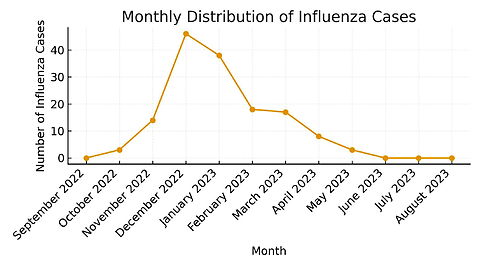
Among 1,344 hospitalized children, 150 (11.2%) had laboratory-confirmed influenza. Ninety children (61.2%) were infected with influenza A and 57 (38.8%) with influenza B. Three patients with dual A/B infection were excluded, leaving 147 children for the final analysis. Their mean age was 3.7 ±3.3 years (range 1 month –14 years), and 81 (55.1%) were male. Most patients were < 7 years old (85.0%). Children with influenza A were younger (3.1 ±3.0 vs. 4.8 ±3.5 years, p = 0.014), had higher C-reactive protein and white blood cell counts (p < 0.05). Bronchiolitis occurred more often in children with influenza A (14.4% vs. 1.7%, p = 0.011). In contrast, children with influenza B more frequently experienced headaches (19.3% vs. 6.7%, p = 0.020), myositis (24.4% vs. 5.5%, p < 0.001) and laboratory abnormalities, including leukopenia (45.6% vs. 22.2%, p = 0.005), thrombocytopenia (22.8% vs. 2.2%, p < 0.001), and increased aspartate aminotransferase > 3× the upper reference limit (22.8% vs. 4.4%, p < 0.001). The most common complications were pneumonia (17.7%) and otitis media (16.3%), regardless of the type of influenza. Most children were unvaccinated (98.6%). The peak incidence occurred in December, with influenza A predominating from October to January and influenza B prevailing during the spring months (p < 0.001).
Conclusions:
Influenza A and B had a broadly similar clinical course; however, the virus type and patient age shaped complication patterns, underscoring the importance of age-adapted clinical assessment and improved preventive strategies in children.
Influenza is exceedingly common in children worldwide and places a substantial burden on healthcare systems. We aimed to evaluate the epidemiology, clinical course, and laboratory characteristics of seasonal influenza in hospitalized children during a single infection season.
Material and methods:
We analyzed data from children with laboratory-confirmed influenza hospitalized at a single center from September 2022 to August 2023. The clinical course was compared across three age groups (< 2, 2–7, and > 7 years) and by influenza type (A or B).
Results:
Among 1,344 hospitalized children, 150 (11.2%) had laboratory-confirmed influenza. Ninety children (61.2%) were infected with influenza A and 57 (38.8%) with influenza B. Three patients with dual A/B infection were excluded, leaving 147 children for the final analysis. Their mean age was 3.7 ±3.3 years (range 1 month –14 years), and 81 (55.1%) were male. Most patients were < 7 years old (85.0%). Children with influenza A were younger (3.1 ±3.0 vs. 4.8 ±3.5 years, p = 0.014), had higher C-reactive protein and white blood cell counts (p < 0.05). Bronchiolitis occurred more often in children with influenza A (14.4% vs. 1.7%, p = 0.011). In contrast, children with influenza B more frequently experienced headaches (19.3% vs. 6.7%, p = 0.020), myositis (24.4% vs. 5.5%, p < 0.001) and laboratory abnormalities, including leukopenia (45.6% vs. 22.2%, p = 0.005), thrombocytopenia (22.8% vs. 2.2%, p < 0.001), and increased aspartate aminotransferase > 3× the upper reference limit (22.8% vs. 4.4%, p < 0.001). The most common complications were pneumonia (17.7%) and otitis media (16.3%), regardless of the type of influenza. Most children were unvaccinated (98.6%). The peak incidence occurred in December, with influenza A predominating from October to January and influenza B prevailing during the spring months (p < 0.001).
Conclusions:
Influenza A and B had a broadly similar clinical course; however, the virus type and patient age shaped complication patterns, underscoring the importance of age-adapted clinical assessment and improved preventive strategies in children.
REFERENCES (30)
1.
Iuliano AD, Roguski KM, Chang HH, Muscatello DJ, Palekar R, Tempia S, et al. Estimates of global seasonal influenza-associated respiratory mortality: a modelling study. Lancet 2018; 391: 1285-1300.
2.
GBD 2017 Influenza Collaborators. Mortality, morbidity, and hospitalisations due to influenza lower respiratory tract infections, 2017: an analysis for the Global Burden of Disease Study 2017. Lancet Respir Med 2019; 7: 69-89.
3.
Doyle JD, Campbell AP. Pediatric influenza and illness severity: what is known and what questions remain? Curr Opin Pediatr 2019; 31: 119-126.
4.
Uyeki TM, Hui DS, Zambon M, Wentworth DE, Monto AS. Influenza. Lancet 2022; 400: 693-706.
5.
Ruf BR, Knuf M. Burden of seasonal and pandemic influenza in infants and children. Eur J Pediatr 2014; 173: 265-276.
6.
Uyeki TM, Bernstein HH, Bradley JS, Englund JA, File TM, Fry AM, et al. IDSA clinical practice guidelines: diagnosis & treatment of seasonal influenza. Clin Infect Dis 2019; 68: e1-e47.
7.
Putri WCWS, Muscatello DJ, Stockwell MS, Newall AT. Economic burden of seasonal influenza in the United States. Vaccine 2018; 36: 3960-3966.
8.
Xu ZW, Li ZJ, Hu WB. Global dynamic spatiotemporal pattern of seasonal influenza since the 2009 pandemic. Infect Dis Poverty 2020; 9: 2.
9.
Wang X, Li Y, O’Brien KL, Madhi SA, Widdowson MA, Byass P, et al. Global burden of respiratory infections associated with influenza in children under 5 years in 2018. Lancet Glob Health 2020; 8: e497-e510.
10.
Nayak J, Hoy G, Gordon A. Influenza in children. Cold Spring Harb Perspect Med 2021; 11: a038430.
11.
Szymański K, Hallmann E, Łuniewska K, Kondratiuk K, Poznańska A, Brydak LB. Spread of influenza viruses in Poland and neighboring countries. Pathogens 2021; 10: 316.
12.
Yildiz I, Gonullu E, Soysal, OnerCN, Karabocuoglu M. Epidemiology of influenza virus infection and group A streptococcal pharyngitis in children. Cureus 2023; 15: e33492.
13.
Jackowska T, Wrotek A, Dembiński Ł, Mazur A, Szczepański T, Toporowska-Kowalska E, et al. Influenza vaccination of children and adolescents in the 2023–2024 season. Prz Pediatr 2023; 52: 16-22.
14.
Angiel K, Stopyra L. Influenza in hospitalized pediatric patients in Poland: a retrospective single-center study of the 2023/2024 epidemic season. Arch Med Sci 2025; 21: 706-709.
15.
Nitsch-Osuch A, Kuchar E, Zycinska K, Gyrczuk E, Wardyn K. Influenza vaccine coverage among children under 5 years in Poland during 2004–2008. Eur J Med Res 2010; 15: 102-104.
16.
Hoy G, Kuan G, López R, Sánchez N, López B, Ojeda S, et al. The spectrum of influenza in children. Clin Infect Dis 2023; 76: e1012-e1020.
17.
Wolf RM, Antoon JW. Influenza in children and adolescents: epidemiology, management, and prevention. Pediatr Rev 2023; 44: 605-617.
18.
Ebell MH, Rahmatullah I, Hulme C, Buhr M, Kotnik JH, Geyer R, et al. Accuracy of individual signs and symptoms and case definitions for the diagnosis of influenza in different age groups: a systematic review with meta-analysis. BMJ Open 2025; 15: e067574.
19.
European Centre for Disease Prevention and Control. Seasonal influenza. Annual epidemiological report 2022–2023.
20.
Sybilski AJ, Mastalerz-Migas A, Jackowska T, Woroń J, Kuchar E, Doniec Z. Recommendations for influenza management in children – COMPAS INFLUENZA, update 2023/2024. Pediatr Fam Med 2023; 19: 273-283.
21.
Dawood FS, Chaves SS, Pérez A, Reingold A, Meek J, Farley MM, et al. Complications and associated bacterial coinfections among children hospitalized with seasonal or pandemic influenza, United States, 2003–2010. J Infect Dis 2014; 209: 686-694.
22.
Klein EY, Monteforte B, Gupta A, Jiang W, May L, Hsieh YH, et al. The frequency of influenza and bacterial coinfection: a systematic review and meta-analysis. Influenza Other Respir Viruses 2016; 10: 394-403.
23.
Hamdan L, Probst V, Haddadin Z, Rahman H, Spieker AJ, Vandekar S, et al. Influenza clinical testing and oseltamivir treatment in hospitalized children with acute respiratory illness, 2015–2016. Influenza Other Respir Viruses 2022; 16: 289-297.
24.
Oh YN, Kim S, Choi YB, Woo SI, Hahn YS, Lee JK. Clinical similarities between influenza A and B in children: a single-center study, 2017/18 season, Korea. BMC Pediatr 2019; 19: 472.
25.
Jané M, Vidal MJ, Soldevila N, Romero A, Martínez A, Torner N, et al. Epidemiological and clinical characteristics of children hospitalized due to influenza A and B in southern Europe, 2010–2016. Sci Rep 2019; 9: 12853.
26.
Yoon JW, Choi DY, Lee SH, Abeywardana S, Jayamaha CJS. Influenza B-associated myositis in children. Korean J Fam Med 2018; 39: 37-41.
27.
Kamin W, Adams O, Kardos P, Matthys H, Meister N, Strassburg CP. Liver involvement in acute respiratory infections in children and adolescents. Front Pediatr 2022; 10: 840008.
28.
Wrotek A, Wrotek O, Jackowska T. Platelet abnormalities in children with laboratory-confirmed influenza. Diagnostics 2023; 13: 634.
29.
Shen CF, Huang SC, Wang SM, Wang JR, Liu CC. Laboratory findings of influenza virus infections in children. J Microbiol Immunol Infect 2008; 41: 294-300.
30.
Shalabi RD, Kassis I, Cohen MS, Dabaja-Younis H. Predictors of unfavorable outcome in children hospitalized with influenza. J Clin Virol 2022; 157: 105298.
Share
RELATED ARTICLE

We process personal data collected when visiting the website. The function of obtaining information about users and their behavior is carried out by voluntarily entered information in forms and saving cookies in end devices. Data, including cookies, are used to provide services, improve the user experience and to analyze the traffic in accordance with the Privacy policy. Data are also collected and processed by Google Analytics tool (more).
You can change cookies settings in your browser. Restricted use of cookies in the browser configuration may affect some functionalities of the website.
You can change cookies settings in your browser. Restricted use of cookies in the browser configuration may affect some functionalities of the website.