ORIGINAL PAPER
Characteristics of rotavirus infections in the region of Silesia between June 2019 and August 2022, in terms of mandatory vaccination
1
Institute of Medical Sciences, University of Opole, Opole, Poland
2
Students’ Scientific Society, Department of Paediatrics, Faculty of Medical Sciences in Katowice, Medical University of Silesia, Katowice, Poland
3
Department of Paediatrics, Faculty of Medical Sciences in Katowice, Medical University of Silesia, Katowice, Poland
Submission date: 2025-11-28
Final revision date: 2026-01-14
Acceptance date: 2026-01-19
Publication date: 2026-03-27
Pediatr Pol 2026;101(1):51-56
KEYWORDS
TOPICS
ABSTRACT
Introduction:
The aim of this study was to evaluate the impact of mandatory rotavirus vaccination introduced in 2021 and COVID-19 pandemic-related restrictions on the incidence, severity, and clinical characteristics of rotavirus-induced acute gastroenteritis in children hospitalised at the Department of Paediatrics, Medical University of Silesia, between June 2019 and October 2022.
Material and methods:
A total of 324 paediatric patients diagnosed with rotavirus infection were included in the analysis. The study compared clinical data before and after the introduction of mandatory vaccination in 2021 in children aged under 6 months and during the COVID-19 pandemic.
Results:
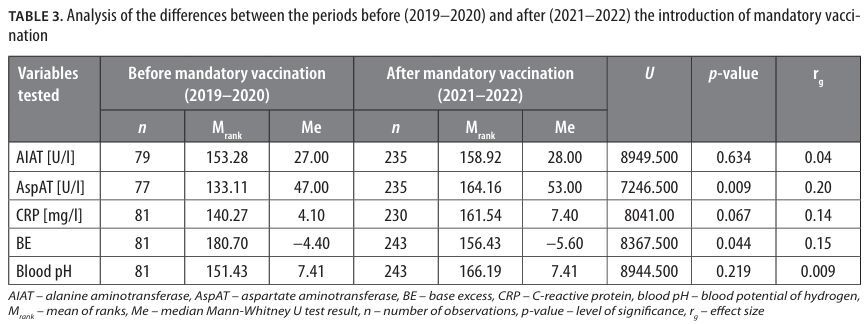
The results indicated a significant decrease in non-vaccinated hospitalisations (non-vaccinated/vaccinated patients) from 98.77% before to 79.84% after the introduction of mandatory vaccination. Post-vaccination, the average age of hospitalised patients increased significantly (mean age: 3 years 7 months, compared to the period before vaccination introduction mean age: 1 year 7 months) and the length of hospital stay was reduced. The study also observed a seasonal peak in rotavirus infections from December 2021 to March 2022, contrasting with the absence of seasonality in previous years, likely due to COVID-19 restrictions. Laboratory findings showed no significant differences in blood pH, C-reactive protein, and alanine aminotransferase levels between the pre- and post-vaccination periods, but there was a significant reduction in base excess, suggesting a milder disease course after vaccination.
Conclusions:
Mandatory rotavirus vaccination and pandemic restrictions are also known to greatly mitigate the severity of the disease and reduce hospital stay in children. Not only do these measures reduce the incidence of severe rotavirus infection in young patients, but they also decrease the economic burden on healthcare systems and alleviate the suffering of young patients. This leads to health benefits for children as well as the reduction in hospitalisation costs. As a result, children’s overall well-being is improved and healthcare resources are more effectively allocated.
The aim of this study was to evaluate the impact of mandatory rotavirus vaccination introduced in 2021 and COVID-19 pandemic-related restrictions on the incidence, severity, and clinical characteristics of rotavirus-induced acute gastroenteritis in children hospitalised at the Department of Paediatrics, Medical University of Silesia, between June 2019 and October 2022.
Material and methods:
A total of 324 paediatric patients diagnosed with rotavirus infection were included in the analysis. The study compared clinical data before and after the introduction of mandatory vaccination in 2021 in children aged under 6 months and during the COVID-19 pandemic.
Results:
The results indicated a significant decrease in non-vaccinated hospitalisations (non-vaccinated/vaccinated patients) from 98.77% before to 79.84% after the introduction of mandatory vaccination. Post-vaccination, the average age of hospitalised patients increased significantly (mean age: 3 years 7 months, compared to the period before vaccination introduction mean age: 1 year 7 months) and the length of hospital stay was reduced. The study also observed a seasonal peak in rotavirus infections from December 2021 to March 2022, contrasting with the absence of seasonality in previous years, likely due to COVID-19 restrictions. Laboratory findings showed no significant differences in blood pH, C-reactive protein, and alanine aminotransferase levels between the pre- and post-vaccination periods, but there was a significant reduction in base excess, suggesting a milder disease course after vaccination.
Conclusions:
Mandatory rotavirus vaccination and pandemic restrictions are also known to greatly mitigate the severity of the disease and reduce hospital stay in children. Not only do these measures reduce the incidence of severe rotavirus infection in young patients, but they also decrease the economic burden on healthcare systems and alleviate the suffering of young patients. This leads to health benefits for children as well as the reduction in hospitalisation costs. As a result, children’s overall well-being is improved and healthcare resources are more effectively allocated.
REFERENCES (27)
1.
Nowakowska A, Demkow U, Podsiadły E. Zakażenia przewodu pokarmowego w XXI wieku w Polsce i na świecie. Post Hig Med Dosw 2021; 75: 48-57.
2.
Crawford SE, Ramani S, Tate JE, Parashar UD, Svensson L, Hagbom M, et al. Rotavirus infection. Nat Rev Dis Primers 2017; 3: 17083.
3.
Poelaert D, Pereira P, Gardner R, Standaert B, Benninghoff B. A review of recommendations for rotavirus vaccination in Europe: arguments for change. Vaccine 2018; 36: 2243-2253.
5.
Troeger C, Khalil IA, Rao PC, Cao S, Blacker BF, Ahmed T, et al. Rotavirus vaccination and the global burden of rotavirus diarrhea among children younger than 5 years. JAMA Pediatr 2018; 172: 958-965.
6.
Mayanskii NA, Mayanskii AN, Kulichenko TV. Rotavirus infection, epidemiology, pathology, vaccination. Ann Russ Acad Med Sci 2015; 70: 47-55.
7.
Amimo JO, Raev SA, Chepngeno J, Mainga AO, Guo Y, Saif L, et al. Rotavirus interactions with host intestinal epithelial cells. Front Immunol 2021; 12: 793841.
8.
Leung AK, Kellner JD, Davies HD. Rotavirus gastroenteritis. Adv Ther 2005; 22: 476-487.
9.
Dian Z, Sun Y, Zhang G, Xu Y, Fan X, Yang X, et al. Rotavirus-related systemic diseases: clinical manifestation, evidence and pathogenesis. Crit Rev Microbiol 2021; 47: 580-595.
10.
Parashar UD, Hummelman EG, Bresee JS, Miller MA, Glass RI. Global illness and deaths caused by rotavirus disease in children. Emerg Infect Dis 2003; 9: 565-572.
11.
Toczylowski K, Jackowska K, Lewandowski D, Kurylonek S, Waszkiewicz-Stojda M, Sulik A. Rotavirus gastroenteritis in children hospitalized in northeastern Poland in 2006–2020: Severity, seasonal trends, and impact of immunization. Int J Infect Dis 2021; 108: 550-556.
12.
Chief Sanitary Inspectorate (Główny Inspektorat Sanitarny). Immunization schedule for 2021. Warszawa 2021.
13.
Burnett E, Parashar UD, Winn A, Tate JE. Trends in rotavirus laboratory detections and internet search volume before and after rotavirus vaccine introduction and in the context of the COVID-19 pandemic – United States, 2000–2021. J Infect Dis 2022; 226: 967-974.
14.
Ogilvie I, Khoury H, Goetghebeur MM, El Khoury AC, Giaquinto C. Burden of community-acquired and nosocomial rotavirus gastroenteritis in the pediatric population of Western Europe: a scoping review. BMC Infect Dis 2012; 12: 62.
15.
Van Chuc D, Linh DP, Linh DV, Van Linh P. Clinical epidemiology features and risk factors for acute diarrhoea caused by rotavirus A in Vietnamese children. Int J Pediatr 2023; 2023: 4628858.
16.
Pérez-Ortín R, Santiso-Bellón C, Vila-Vicent S, Carmona-Vicente N, Rodríguez-Díaz J, Buesa J. Rotavirus symptomatic infection among unvaccinated and vaccinated children in Valencia, Spain. BMC Infect Dis 2019; 19: 998.
17.
Peer V, Schwartz N, Green MS. A pooled analysis of sex differences in rotaviral enteritis incidence rates in three countries over different time periods. Womens Health Rep (New Rochelle) 2022; 3: 228-237.
18.
Lewnard JA, Lopman BA, Parashar UD, Bennett A, Bar-Zeev N, Cunliffe NA, et al. Heterogeneous susceptibility to rotavirus infection and gastroenteritis in two birth cohort studies: parameter estimation and epidemiological implications. PLoS Comput Biol 2019; 15: e1007014.
19.
Koukou DM, Michos A, Chatzichristou P, Trimis G, Tatsi EB, Dellis C, et al. Rotavirus epidemiology and genotype distribution in hospitalised children, Greece, 2008–2020: a prospective multicentre study. Euro Surveill 2022; 27: 2101133.
20.
Indrawan M, Chendana J, Handoko TGH, Widjaja M, Sterling Octavius G. Clinical factors predicting rotavirus diarrhea in children: a cross-sectional study from two hospitals. World J Clin Pediatr 2023; 12: 319-330.
21.
Djikoloum B, Abakar MF, Ndze VN, Nkandi RG, Enjeh CN, Kimala P, et al. Epidemiology of group A rotavirus in children under five years of age with gastroenteritis in N’Djamena, Chad. BMC Infect Dis 2024; 24: 111.
22.
Patel MM, Pitzer VE, Alonso WJ, Vera D, Lopman B, Tate J, et al. Global seasonality of rotavirus disease. Pediatr Infect Dis J 2013; 32: 134-147.
23.
Karafillakis E, Hassounah S, Atchison C. Effectiveness and impact of rotavirus vaccines in Europe, 2006–2014. Vaccine 2015; 33: 2097-2107.
24.
Pindyck T, Tate JE, Parashar UD. A decade of experience with rotavirus vaccination in the United States –vaccine uptake, effectiveness, and impact. Expert Rev Vaccines 2018; 17: 593-606.
25.
Burns HE, Collins AM, Fallon UB, Marsden PV, Ni Shuilleabhain CM. Rotavirus vaccination impact, Ireland: implications for vaccine confidence and screening. Eur J Public Health 2020; 30: 281-285.
26.
Zhou J, Sun Y. Effect of COVID-19 protective measures on the epidemiology characteristics of rotavirus, adenovirus, and coinfections among pediatric patients with acute gastroenteritis in Hangzhou, China. Microbiol Spectr 2024; 12: e0400723.
27.
Maruo Y, Ishikawa S, Oura K, Shiraishi H, Sato N, Suganuma T, et al. The impact of the coronavirus disease 2019 pandemic on pediatric hospitalization in Kitami, Japan. Pediatr Int 2022; 64: e14937.
Share
RELATED ARTICLE

We process personal data collected when visiting the website. The function of obtaining information about users and their behavior is carried out by voluntarily entered information in forms and saving cookies in end devices. Data, including cookies, are used to provide services, improve the user experience and to analyze the traffic in accordance with the Privacy policy. Data are also collected and processed by Google Analytics tool (more).
You can change cookies settings in your browser. Restricted use of cookies in the browser configuration may affect some functionalities of the website.
You can change cookies settings in your browser. Restricted use of cookies in the browser configuration may affect some functionalities of the website.