ORIGINAL PAPER
Analysis of selected biomarkers of obesity-related complications in the paediatric population
1
Faculty of Pharmacy, Wroclaw Medical University, Wroclaw, Poland
2
Clinical Department of Paediatric Nephrology, Faculty of Medicine, Wroclaw Medical University, Wroclaw, Poland
3
Screening of Biological Activity Assays and Collection of Biological Material Laboratory, Faculty of Pharmacy, Wroclaw Medical University, Wroclaw Medical University Biobank, Wroclaw, Poland
4
Department of Population Research and Prevention of Lifestyle Diseases, Faculty of Health Sciences, Wroclaw Medical University, Wroclaw, Poland
5
Department of Otolaryngology, Head and Neck Surgery, Faculty of Medicine, Wroclaw Medical University, Wroclaw, Poland
These authors had equal contribution to this work
Submission date: 2025-11-13
Final revision date: 2025-12-07
Acceptance date: 2025-12-12
Publication date: 2026-03-27
Pediatr Pol 2026;101(1):36-42
KEYWORDS
TOPICS
ABSTRACT
Introduction:
Childhood obesity is a growing global health concern, strongly associated with chronic low-grade inflammation and increased risk of metabolic, cardiovascular, and renal complications. Identifying early biomarkers of obesity-related disorders is essential for timely intervention and prevention. This study aimed to evaluate selected serum and urinary biomarkers in children and adolescents aged 8–18 years to assess their relationship with overweight and obesity and their potential as early indicators of metabolic disturbances.
Material and methods:
A total of 268 participants were included: 200 children with excessive body weight (body mass index – BMI ≥ 85th percentile) and 68 children with normal weight (BMI < 85th percentile), classified according to the Polish OLAF percentile charts. Biochemical markers analysed in serum included high-density lipoprotein (HDL)-C, low-density lipoprotein (LDL)-C, creatinine (Cr), uric acid, isthmin-1, visfatin, resistin, and in urine, α-1-acid glycoprotein (α1AGP)/Cr.
Results:
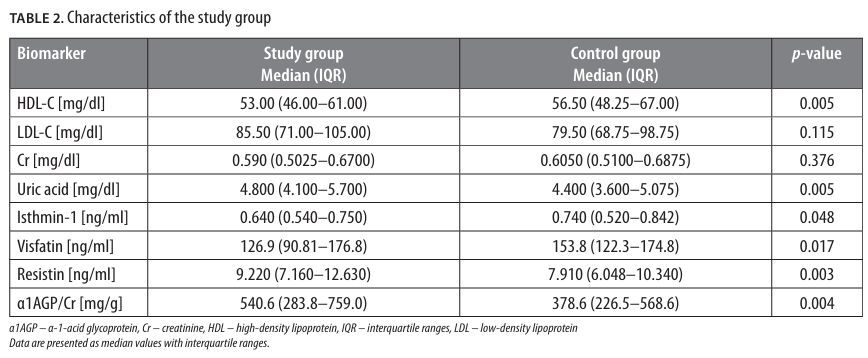
The study group had significantly lower HDL-C concentrations compared to their normal-weight peers. No statistically significant differences were observed in LDL-C or serum Cr levels between the groups. However, the study group exhibited significantly higher serum resistin levels and an elevated urine α1AGP/Cr. In contrast, concentrations of serum isthmin-1 and visfatin were significantly lower in the study group than in the control group. Correlation analysis using Spearman’s test showed no significant associations between concentrations of adipokines and uric acid.
Conclusions:
This study demonstrated significant differences in biochemical and inflammatory markers between children with overweight/obesity and their normal-weight peers, including decreased HDL-C and visfatin, lower isthmin-1, and elevated resistin and α1AGP/Cr. These findings may reflect early metabolic and inflammatory disturbances that occur even before clinical symptoms arise. The lack of correlation between adipokines and uric acid suggests distinct, independent mechanisms involved in obesity-related complications. Monitoring these biomarkers may support early detection and prevention strategies in paediatric populations at risk of metabolic disorders.
Childhood obesity is a growing global health concern, strongly associated with chronic low-grade inflammation and increased risk of metabolic, cardiovascular, and renal complications. Identifying early biomarkers of obesity-related disorders is essential for timely intervention and prevention. This study aimed to evaluate selected serum and urinary biomarkers in children and adolescents aged 8–18 years to assess their relationship with overweight and obesity and their potential as early indicators of metabolic disturbances.
Material and methods:
A total of 268 participants were included: 200 children with excessive body weight (body mass index – BMI ≥ 85th percentile) and 68 children with normal weight (BMI < 85th percentile), classified according to the Polish OLAF percentile charts. Biochemical markers analysed in serum included high-density lipoprotein (HDL)-C, low-density lipoprotein (LDL)-C, creatinine (Cr), uric acid, isthmin-1, visfatin, resistin, and in urine, α-1-acid glycoprotein (α1AGP)/Cr.
Results:
The study group had significantly lower HDL-C concentrations compared to their normal-weight peers. No statistically significant differences were observed in LDL-C or serum Cr levels between the groups. However, the study group exhibited significantly higher serum resistin levels and an elevated urine α1AGP/Cr. In contrast, concentrations of serum isthmin-1 and visfatin were significantly lower in the study group than in the control group. Correlation analysis using Spearman’s test showed no significant associations between concentrations of adipokines and uric acid.
Conclusions:
This study demonstrated significant differences in biochemical and inflammatory markers between children with overweight/obesity and their normal-weight peers, including decreased HDL-C and visfatin, lower isthmin-1, and elevated resistin and α1AGP/Cr. These findings may reflect early metabolic and inflammatory disturbances that occur even before clinical symptoms arise. The lack of correlation between adipokines and uric acid suggests distinct, independent mechanisms involved in obesity-related complications. Monitoring these biomarkers may support early detection and prevention strategies in paediatric populations at risk of metabolic disorders.
REFERENCES (37)
1.
World Health Organization Regional Office for Europe. WHO European Regional Obesity Report 2022. Copenhagen: WHO Regional Office for Europe; 2022. Licence: CC BY-NC-SA 3.0 IGO.
2.
Pawlewicz A. Otyłość i jej konsekwencje. National Health Fund, Department of Analysis, Quality Monitoring and Services Optimization, Warsaw 2024.
3.
Mazur A, Zachurzok A, Baran J, Dereń K, Łuszczki E, Weres A, et al. Otyłość dziecięca. Stanowisko Polskiego Towarzystwa Pediatrycznego, Polskiego Towarzystwa Otyłości Dziecięcej, Polskiego Towarzystwa Endokrynologii i Diabetologii Dziecięcej, Kolegium Lekarzy Rodzinnych w Polsce oraz Polskiego Towarzystwa Badań nad Otyłością. Med Prakt Pediatr 2023; 1: 5-43.
4.
Yim H, Yoo K. Obesity and chronic kidney disease: prevalence, mechanism, and management. Clin Exp Pediatr 2021; 64: 511-518.
5.
Kułaga Z, Różdżyńska A, Palczewska I, Napieralska E, Litwin M, Różdżyńska-Świątkowska A, et al. Siatki centylowe wysokości, masy ciała i wskaźnika masy ciała dzieci i młodzieży w Polsce – wyniki badania OLAF. Stand Med Pediatr 2010; 7: 690-700.
6.
Medyńska A, Chrzanowska JM, Kościelska-Kasprzak K, Bartoszek D, Żabińska M, Zwolińska D. Alpha-1 acid glycoprotein and podocin mRNA as novel biomarkers for early glomerular injury in obese children. J Clin Med 2021; 10: 4129.
7.
Zatońska K, Basiak-Rasała A, Matera-Witkiewicz A. Population Cohort Study of Wroclaw Citizens (PICTURE) – study protocol. J Health Inequal 2022; 8: 37-43.
8.
Matera-Witkiewicz A, Gleńska-Olender J, Zagórska K, Uhrynowska-Tyszkiewicz I, Witoń M. Standardy jakości dla biobanków polskich v. 2.00. Uniwersytet Medyczny im. Piastów Śląskich, Wrocław 2021, 50.
9.
Smirnov NV. Table for estimating the goodness of fit of empirical distributions. Ann Math Statist 1948; 19: 279-281.
10.
Mann HB, Whitney DR. On a test of whether one of two random variables is stochastically larger than the other. Ann Math Statist 1947; 18: 50-60.
11.
Brzeziński M, Metelska P, Myśliwiec M, Szlagatys-Sidorkiewicz A. Lipid disorders in children living with overweight and obesity – large cohort study from Poland. Lipids Health Dis 2020; 19: 47.
12.
Hui N, Barter P, Ong K, Rye KA. Altered HDL metabolism in metabolic disorders: insights into the therapeutic potential of HDL. Clin Sci 2019; 133: 2221-2235.
13.
McPhee PG, Singh S, Morrison KM. Childhood obesity and cardiovascular disease risk: working toward solutions. Can J Cardiol 2020; 36: 1352-1361.
14.
Cho K. Biomedicinal implications of high-density lipoprotein: its composition, structure, functions, and clinical applications. BMB Rep 2009; 42: 393-400.
15.
Cho K. The current status of research on high-density lipoproteins (HDL): a paradigm shift from HDL quantity to HDL quality and HDL functionality. Int J Mol Sci 2022; 23: 3967.
17.
Nur Zati Iwani AK, Jalaludin MY, Roslan FA, MansorF, Zain F, Hua Hong JY, et al. Cardiometabolic risk factors among children who are affected by overweight, obesity and severe obesity. Front Public Health 2023; 11: 1097675.
18.
Yanai H, Adachi H, Hakoshima M, Katsuyama H. Molecular biological and clinical understanding of the pathophysiology and treatments of hyperuricemia and its association with metabolic syndrome, cardiovascular diseases and chronic kidney disease. Int J Mol Sci 2021; 22: 9221.
19.
Li M, Hou W, Zhang X, Choi HK, Heitjan DF, Albert DA. Hyperuricemia and risk of stroke: a systematic review and meta-analysis of prospective studies. Atherosclerosis 2014; 232: 265-270.
20.
Dutta A, Henley W, Pilling L, Wallace RB, Melzer D. Uric acid measurement improves prediction of cardiovascular mortality in later life. J Am Geriatr Soc 2013; 61: 319-326.
21.
Li M, Hu X, Fan Y, Li K, Zhang X, Hou W, et al. Hyperuricemia and the risk for coronary heart disease morbidity and mortality: a systematic review and dose-response meta-analysis. Sci Rep 2016; 6: 19520.
22.
Jiang Z, Zhao M, Voilquin L, Jung Y, Aikio MA, Sahai T, et al. Isthmin-1 is an adipokine that promotes glucose uptake and improves glucose tolerance and hepatic steatosis. Cell Metab 2021; 33: 1836-1852.e11.
23.
Gao G, Zhou Z. Isthmin-1: a critical regulator of branching morphogenesis and metanephric mesenchyme condensation during early kidney development. BioEssays 2023; 45: e2300189.
24.
Xu M, Feng R, Feng R, Yin X, Zhang L, Wang C, et al. Glomerular filtration rate in patients with type 2 diabetes mellitus: is serum isthmin-1 level a possible link? BMJ Open Diabetes Res Care 2023; 11: e003402.
25.
Alshawaf E, Marafie SK, Abu-Farha M, Albatineh AN, Alramah T, Albuhairi A, et al. Circulating Isthmin-1 levels and their relationship with diabetes and metabolic diseases in Kuwaiti adults. Biomedicines 2025; 13: 101.
26.
Ruiz-Ojeda FJ, Anguita-Ruiz A, Rico MC, Leis R, Bueno G, Moreno LA, et al. Serum levels of the novel adipokine isthmin-1 are associated with obesity in pubertal boys. World J Pediatr 2022; 19: 864-872.
27.
Kostapanos M, Derdemezis C, Filippatos T, Milionis HJ, Kiortsis DN, Tselepis AD, et al. Effect of rosuvastatin treatment on plasma visfatin levels in patients with primary hyperlipidemia. Eur J Pharmacol 2008; 578: 249-252.
28.
Kaminska A, Kopczynska E, Bronisz A, Żmudzińska M, Bieliński M, Borkowska A, et al. An evaluation of visfatin levels in obese subjects. Endokrynol Pol 2010; 61: 169-173.
29.
Zahorska‐Markiewicz B, Olszanecka-Glinianowicz M, Janowska J, Kocełak P, Semik-Grabarczyk E, Holecki M, et al. Serum concentration of visfatin in obese women. Metabolism 2007; 56: 1131-1134.
30.
Chang YH, Chang DM, Lin K, Shin SJ, Lee YJ. Visfatin in overweight/obesity, type 2 diabetes mellitus, insulin resistance, metabolic syndrome and cardiovascular diseases: a meta‐analysis and systemic review. Diabetes Metab Res Rev 2011; 27: 515-527.
31.
Jin H, Jiang B, Tang J, Lu W, Wang W, Zhou L, et al. Serum visfatin concentrations in obese adolescents and its correlation with age and high-density lipoprotein cholesterol. Diabetes Res Clin Pract 2008; 79: 412-418.
32.
Sun G, Bishop J, Khalili S, Vasdev S, Gill V, Pace D, et al. Serum visfatin concentrations are positively correlated with serum triacylglycerols and down-regulated by overfeeding in healthy young men. Am J Clin Nutr 2007; 85: 399-404.
33.
Lee KJ, Shin YA, Lee KY, Jun TW, Song W. Aerobic exercise training-induced decrease in plasma visfatin and insulin resistance in obese female adolescents. Int J Sport Nutr Exerc Metab 2010; 20: 275-281.
34.
Santilli F, Liani R, Di Fulvio P, Formoso G, Simeone P, Tripaldi R, et al. Increased circulating resistin is associated with insulin resistance, oxidative stress and platelet activation in type 2 diabetes mellitus. Thromb Haemost 2016; 116: 1089-1099.
35.
Romejko K, Rymarz A, Szamotulska K, Bartoszewicz Z, Rozmyslowicz T, Niemczyk S. Resistin contribution to cardiovascular risk in chronic kidney disease male patients. Cells 2023; 12: 999.
36.
Tripathi D, Kant S, Pandey S, Ehtesham NZ. Resistin in metabolism, inflammation and disease. FEBS J 2020; 287: 1815-1827.
37.
Koch V. Obesity facts and their influence on renal function across the life span. Front Med 2021; 8: 704409.
Share
RELATED ARTICLE

We process personal data collected when visiting the website. The function of obtaining information about users and their behavior is carried out by voluntarily entered information in forms and saving cookies in end devices. Data, including cookies, are used to provide services, improve the user experience and to analyze the traffic in accordance with the Privacy policy. Data are also collected and processed by Google Analytics tool (more).
You can change cookies settings in your browser. Restricted use of cookies in the browser configuration may affect some functionalities of the website.
You can change cookies settings in your browser. Restricted use of cookies in the browser configuration may affect some functionalities of the website.