CASE REPORT
A case series on pediatric tinea capitis
1
Students’ Scientific Association of Experimental, Clinical and Surgical Dermatology, Medical University of Lodz, Lodz, Poland
2
Zakrzewscy Clinic sp. z o.o., Katowice, Poland
3
Department of Dermatology, Pediatric Dermatology and Oncology, Medical University of Lodz, Lodz, Poland
4
Laboratory of Autoinflammatory, Genetic and Rare Skin Disorders, Department of Dermatology, Pediatric Dermatology and Oncology, Medical University of Lodz, Lodz, Poland
Submission date: 2025-04-13
Final revision date: 2025-11-11
Acceptance date: 2025-11-20
Publication date: 2026-03-23
Pediatr Pol 2026;101(1):87-94
KEYWORDS
TOPICS
ABSTRACT
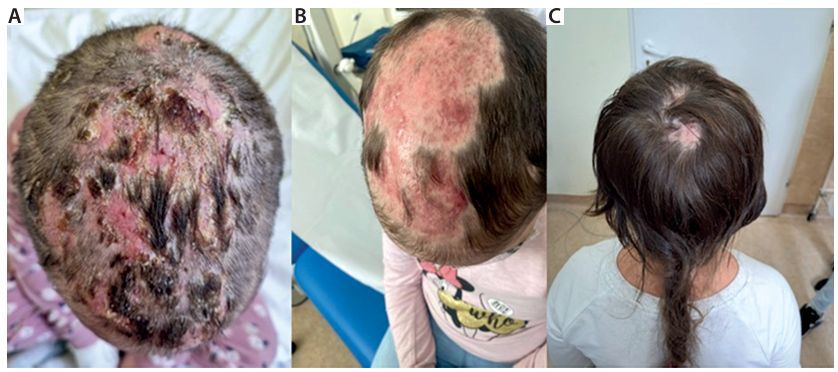
Tinea capitis, a dermatophyte infection of the scalp mainly caused by zoophilic and, less commonly, anthropophilic species, predominantly affects prepubertal children. Clinically, it presents with scalp scaling, hair loss, alopecia with scaly plaques, or alopecia with “black dots” from broken hairs at follicular openings. Severe forms, such as tinea profunda, may progress to suppurative lesions, pustules, and thick crusts. Standard systemic treatments include terbinafine, itraconazole, fluconazole, and griseofulvin (currently unavailable in Poland). The choice and duration of therapy depend on the infection severity and dermatophyte species. This case series of five pediatric patients illustrates the varied clinical presentations of tinea capitis and highlights the importance of early diagnosis and prompt systemic antifungal therapy to prevent irreversible outcomes, including permanent alopecia and scarring. The review of clinical cases and literature underscores that timely and adequate therapeutic intervention is essential to optimize outcomes in the affected children.
REFERENCES (25)
1.
Leung KC, Hon KL, Leong KF, Barankin B, Lam JM. Tinea capitis: an updated review. Recent Pat Inflamm Allergy Drug Discov 2020; 14: 58-68.
2.
Güleç T. Trichoscopic evaluation of tinea capitis. Mycopathologia 2023; 188: 553-561.
3.
Gupta AK, Ravi SP, Wang T, Faour S, Bamimore MA, Heath CR, et al. An update on tinea capitis in children. Pediatr Dermatol 2024; 41: 1030-1039.
4.
Kovitwanichkanont T, Chong AH. Superficial fungal infections. Aust J Gen Pract 2019; 48: 706-711.
5.
John M, Schwartz RA, Janniger CK. The kerion: an angry tinea capitis. Int J Dermatol 2018; 57: 3-9.
6.
Ion A, Popa LG, Porumb-Andrese E, Dorobanțu AM, Tătar R, Giurcăneanu C, et al. A current diagnostic and therapeutic challenge: tinea capitis. J Clin Med 2024; 13: 376.
7.
Alkeswani A, Cantrell W, Elewski B. Treatment of tinea capitis. Skin Appendage Disord 2019; 5: 201.
8.
Wei S, Wang H, Li A, Yuan C. Kerion Celsi caused by Microsporum gypseum in a Chinese child, a case report. Medicine (United States) 2022; 101: E28936.
9.
Sabzghabaee M, Mansouri P, Mohammadi M. Safety and efficacy of terbinafine in a pediatric Iranian cohort of patients with Tinea capitis. Saudi Pharm J SPJ 2009; 17: 243.
10.
Kakourou T, Uksal U, Oranje AP. Guidelines for the management of tinea capitis in children. Pediatr Dermatol 2010; 27: 226-228.
11.
Ely JW, Rosenfeld S, Stone MS. Diagnosis and management of tinea infections. Am Fam Physician 2014; 90: 702-711.
12.
Zheng Y, Zhang J, Chen H, Lai W, Maibach HI. Terbinafine-induced lichenoid drug eruption. Cutan Ocul Toxicol 2017; 36: 101-103.
13.
Bhatia GA, Kanish B, Williams A. Terbinafine induced pityriasis rosea-like eruption. Indian J Pharmacol 2015; 47: 680-681.
14.
Deng S, Hu H, Abliz P, Wan Z, Wang A, Cheng W, et al. A random comparative study of terbinafine versus griseofulvin in patients with tinea capitis in Western China. Mycopathologia 2011; 172: 365-372.
15.
Fuller LC, Barton RC, Mohd Mustapa MF, Proudfoot LE, Punja- bi SP, Higgins EM. British Association of Dermatologists’ guidelines for the management of tinea capitis 2014. Br J Dermatol 2014; 171: 454-463.
16.
González U, Seaton T, Bergus G, Jacobson J, Martínez-Monzón C. Systemic antifungal therapy for tinea capitis in children. Cochrane Database Syst Rev 2007; 4: CD004685.
17.
Castelo-Soccio L. Diagnosis and management of hair loss in children. Curr Opin Pediatr 2016; 28: 483-489.
18.
Bin Zhou Y, Xiao YY, Chao JJ, Ma L. A novel itraconazole pulse therapy schedule in the treatment of tinea capitis in children. Clin Cosmet Investig Dermatol 2021; 14: 1799.
19.
Chen S, Sun KY, Feng XW, Ran X, Lama J, Ran YP. Efficacy and safety of itraconazole use in infants. World J Pediatr 2016; 12: 399-407.
20.
Binder B, Richtig E, Weger W, Ginter-Hanselmayer G. Tinea capitis in early infancy treated with itraconazole: a pilot study. J Eur Acad Dermatol Venereol 2009; 23: 1161-1163.
21.
Schauder S. Itraconazole in the treatment of tinea capitis in children. Case reports with long-term follow-up evaluation. Review of the literature. Mycoses 2002; 45: 1-9.
22.
Dastghaib L, Azizzadeh M, Jafari P. Therapeutic options for the treatment of tinea capitis: griseofulvin versus fluconazole. J Dermatol Treat 2005; 16: 43-46.
23.
Dascalu J, Zaaroura H, Renert-Yuval Y, Khamaysi Z, Avitan-Hersh E, Friedland R. Pediatric tinea capitis: a retrospective cohort study from 2010 to 2021. J Fungi (Basel) 2023; 9: 366.
24.
Kumar P, Pandhi D. Role of trichoscopy in the management of tinea capitis in two infants: a case report. J Cutan Aesthet Surg 2021; 14: 443.
25.
Chokoeva AA, Wollina U, Lotti T, Maximov GK, Lozev I, Tcher- nev G. Psoriasiform dermatophytosis in a Bulgarian child. Open Access Maced J Med Sci 2018; 6: 118.

We process personal data collected when visiting the website. The function of obtaining information about users and their behavior is carried out by voluntarily entered information in forms and saving cookies in end devices. Data, including cookies, are used to provide services, improve the user experience and to analyze the traffic in accordance with the Privacy policy. Data are also collected and processed by Google Analytics tool (more).
You can change cookies settings in your browser. Restricted use of cookies in the browser configuration may affect some functionalities of the website.
You can change cookies settings in your browser. Restricted use of cookies in the browser configuration may affect some functionalities of the website.